Earth Cube as a Double Loop organization

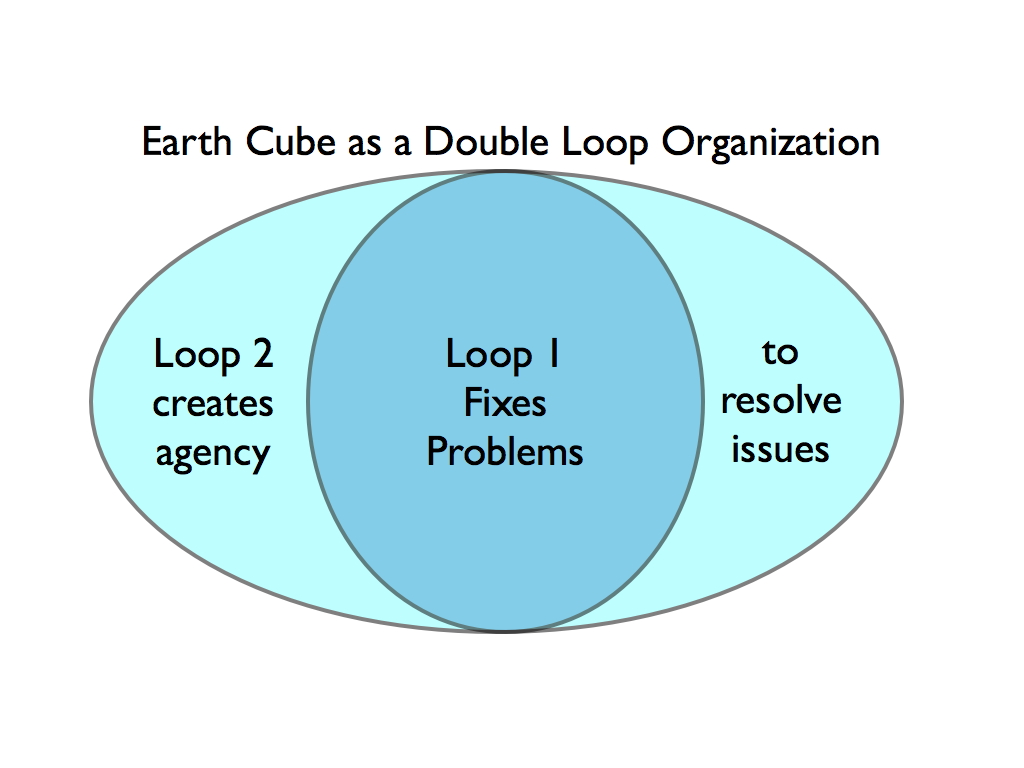
I’ve been listening in on the opening discussions at the Earth Cube governance meeting, and I’m impressed by the level of passion and amount of expertise at the table. I’m also interested in how the conversations seem to whiplash from notions of democracy and community to ideas for data standards. People have come to the table with divergent notions of what governance means, although they are also aware that governance can mean both democracy and data standards. I would like to argue that they are looking at the same organization, but they are each describing only one of the governance “loops” that will be needed for Earth Cube.

Take a look at this Keynote talk by Clay Shirky (DrupalCon 2011)

http://archive.org/details/drupalconchi_day2_keynote_clay_shirky

about 45 minutes into the video Clay is talking about organizations that not only fix problems, but that simultaneously can solve the larger issues that created the problems. In these “double-loop” organizations, the members agree to governance rules that solve common problems for their interactions (e.g., data sharing). At the same time, they agree to own these rules, that is, to govern their governance system. And so, when someone talks about building community, protecting expressive capabilities, voting, officers, and working consensus, constitution and bylaws, vision statements and goals: they are approaching Earth Cube governance from the second loop. This is where the members of Earth Cube agree to be its owners. And when someone talks about data sharing policies (enforcement, compliance, standards, etc.) for Earth Cube, they are also bringing to the table issues integral to governance. These are the activities, the goals, and the outcomes of Earth Cube as a distributed/virtual organization.

First loop governance fixes problems for the Earth Cube member community. Second loop governance creates what sociologists call “agency.” This agency is the ability/capability to govern how the community will fix its problems. Does there need to be a committee? Who gets to be on the committee? Who is involved in a decision? Who do you talk to if you feel your voice has not been heard? Second-loop governance is responsible to answer all of these questions. In a typical NSF project, this is called “management.” PI and Co-PIs are charged to create and implement an effective management plan. But who should create and implement an effective second-loop governance plan? The current vision for Earth Cube puts the community into this role. Members of the community are stepping up to guide this process. But a much larger community-wide conversation will need to happen before any second-loop governance plan can be implemented.

What about first-loop governance planning? When should this happen, and how? Initial discussions about the scope of the problems to be fixed and the solution spaces for these fixes will help articulate the amount of (loop-one) governance activities needed to effect the fixes. The model that emerges will guide the second-loop governance planners to better solutions for their level of governance. For example, if community buy-in to a strict set of data standards is needed, then the second-loop governance effort will need to plan to build a strong community. If the main requirement is better communication, then a much weaker community will suffice.  But again, these discussions will need to be revisited after the second-loop governance effort is agreed to by the members. So the governance boot-strapping process will resonate between the two loops until the initial governance plan is accepted by the Earth Cube members. At that point, the second-loop governance is empowered to address new fixes, and to fix itself whenever this is needed.

A good example of this can be found in the history of the ESIP Federation. The Federation spent more than two years, and included direct participation by several dozen members before it finalized its constitution and bylaws (the main second-loop outcome). When the final vote was taken, and these documents were accepted by consensus, then the various committees, and emergent working groups and thematic “clusters” were supported to begin to fix problems faced by Federation members: data interoperability and stewardship being chief among these.

Building a governance model for Earth Cube will require looking into both loops: the first loop describes a number of fixes planned to address common problems (mainly around data use and sharing), while the second loop describes how the Earth Cube community can acquire ownership for the decision processes to determine which fixes are most important, and how to engage the broader community in their implementation.

Community Engagement: your agency does not have the budget to not support this

Funded research that includes a charge to engage a community (of scholars, end users, students, etc.) in doing this research, or in using its products (data, metadata, standards, etc.) is usually underfunded. There are two simple reasons for this. The first reason is that agencies typically underestimate the cost of doing community engagement through community governance. The second is that money is a very poor instrument for directly accomplishing engagement, mainly because of the perverse effects this has on volunteerism.

At the same time, efforts to support “community” are often pursued without actually building community-based governance. Project budgets may include large amounts of “participant support” for annual “community meetings” that could help build engagement. But without the governance structure that puts the community in a position to determine key aspects of the core activities, these meetings are really only very expensive alternatives to an email list. The attendees may learn something, and will forge their own interpersonal connections, but the work of building community through governance is left undone.

I was once “voted” onto the policy committee of a large agency-funded effort. The first thing we were told, after they flew us in to the annual “community” meeting, was that the committee did not make policies. Similarly, the act of voting was used without any available model of membership. There are better ways to get the community engaged.

One of the reasons that community engagement has become more visible as a goal is the realization that “network effects” can greatly amplify the impacts of a research project’s outcomes.  Indeed, Metcalfe’s Law tells us that value of a network is proportional to the square of the number of members (n2). Bringing network effects to research collaboratories can accelerate communication of ideas and knowledge sharing. A more recent study by David Reed points to an even larger effect: that of group-forming networks. Networks that allow members to self select into smaller groups (clusters) approach an exponential increase in the scale of interactions (2n), a scale that grows much faster than any power law distribution. Enabling the network to create internal, purposeful subgroups where members are highly engaged is one strategy that can really pay off for a funded research project.

The two curves in these graphs are familiar to most. The top one is the “power law” curve, which describes many distributions, notably, the expected relationship between the amount of attention/activity on an open Internet network in relation to the number of people so engaged. This is the usual “10% of the members do 90% of the work” situation. The bottom curve is the “bell curve” normal distribution, where the main mode is high-activity. What is important to notice here is that the space under the normal curve is much larger than the space under the power law curve. Much more activity is happening here, even if the number of people are the same.

The use of community-led governance to foster engagement is covered in several other posts on this site. There are some real examples of this that can be studied. The Federation of Earth Science Information Partners (ESIPfed.org) is one.  I would guess that many agency program managers can point to histories of counter examples: of projects that never created any governance capabilities, even while they spend huge amounts of budget on “community.”

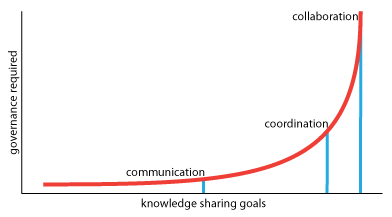
The amount of real governance required to support activities also depends on what types of activities need to be supported. If communication is the goal, then a relatively weak governance system will suffice. If real collaborations (those purposeful subgroups) are to be supported, then a robust governance system may be needed. Clay Shirky examines three levels of social interaction: communication, coordination, and collaboration. Each of these levels needs its own type of governance.

Distributing activities across an engaged volunteer network of peers can use a very limited budget to accomplish everything that needs to be done. Money is not the driving force here. It is rarely the case that agencies cannot afford to support governance through project research budgets; more to the point, they cannot afford to not support this if they want to accomplish what only a community can do.

Volunteers or staff: Who is holding up your virtual organization?

Getting the right mix of staff and volunteers for a virtual organization is a crucial task for sustainability. The key is to take limited resources (if you have unlimited resources, call me) and invest these in directions that bring the best return for all.

What are volunteers good for? Many a community organizer has had moments when the answer to this is all too clear. Thankfully, those moments do pass. Volunteers are the heart of a virtual organization. Keeping this organ alive and well is job one for staff. Volunteers bring skills, vision, energy, and passion to the organization. They tend to do so in short-term increments. They need to know their efforts are valuable. This knowledge prompts them to stay engaged. Through the serial engagement of many volunteers, certain activities are maintained: governance, oversight, incremental work on infrastructure, a supply of new ideas, and, yes, occasional sidetracks. Nobody can sell your organization to donors and new partners better than volunteers. And nobody can grow your organization over time and on budget like volunteers.

What is your staff good for? Staff are the backbone of any virtual organization. They keep it on track and guide its fortunes. They have responsibility for those tasks that volunteers should not be asked to perform (more about this soon). They also have responsibility to keep volunteers engaged. They do the thank-less work and get paid for this. But that doesn’t mean the organization doesn’t owe them a heap of thanks. Still, they are professionals, and need to step up an take charge when the need arises. Generically, the work of staff falls into two buckets: everyday necessary tasks and putting out fires. Volunteers should not be asked to perform these types of work. Staff run the events on the organization’s calendar; they manage the web-presence, the accounting, the teleconferences, and a hundred day-to-day activities. They facilitate volunteer efforts. And, when the website is hacked, or the projector bulb burns out, they fix it.

Volunteers get called in to plan and direct new activities and articulate new goals. Ideally, they are given a say (not just a voice) in the organization’s operational budget. Because they do the planning and determine the budget, it’s only fair that they do some of the work. They can be tasked to scope out any new work required by a new goal and to build new capabilities to meet this. Then they either do the work, or determine that the job is too big for them to accomplish. When the volunteers are done with their efforts, the outcomes are passed back to staff to incorporate into the organization’s operational inventory. Sometimes the outcomes are not fully ready to use (having been built by volunteers). Staff might need to hire an outside expert to polish the work. Note: this person should be fully “outside” and not a community member. Never hire a community member as a consultant to fix another community member’s volunteered contribution.

When the job is too big, volunteers might ask for some support (more often they just stop answering emails). There are many ways to support volunteers. Paying them is the least valuable, as this transforms them into non-volunteers. There are several descriptions of the negative impacts of paying volunteers. Basically you are pissing in your own soup. Other means of support are always better: find them assistants (pay for interns), pay their travel, pay for hardware and software when required, and, if nothing else works, add staff to help. Sometimes, this might mean making a skilled volunteer a “fellow” for a short period of time. This move should include a community vote, including an open call for the fellow position within the community. The community is tasked to help staff fill a temporary (less than a year) need from within their ranks. By this, the “fellow” can be paid for a time and then return to the ranks of the volunteer community.

Remember that volunteers need to know their efforts are valuable. The organization needs to build and maintain recognition systems for volunteers. These include online and in-person awards. The three motivations for engagement are money, love, and glory. When it comes to volunteers, if you are stingy with the glory, don’t expect any love. And when you let the community add to their own glory, then you can stand back and watch new leaders emerge and know your virtual organization is healthy and growing.

Image Credit: Used on CC license. Photographer: Leo Reynolds on Flickr

Unintended Consequences Mock our Best Efforts

The dog was just a puppy, and it came rocketing across the street with its tail down. The dog’s owner, rummaging in his garage, the door open, yells out to dog. It’s some kind of lab mix and it jumps up on us with joy. We are mindful of the traffic on the street, and corral the pup by its collar. The owner trots over and we pass the dog back to him.

“Is it a lab?” my wife asked.

“Some kind of mix,” he said. “I got him from a shelter. They don’t euthanize here, so we went down to Riverside where they do, and rescued him.”

My wife has volunteered for years at the local Humane Society, where they struggle to find owners for their orphaned pups and kittens. Their pledge to not euthanize was designed to reassure locals of a mutual responsibility to manage their pets. Unintentionally, the Humane Society has also “rescued” their charges from death, and by doing so has removed that action from the scope of the people who come in to find a pet.

*******************

The local blood bank in Santa Barbara ran as a non-profit organization for decades, as a vital partner in local health and medical services. One day it announced that it was selling its operation to a for-profit blood services organization that would help manage the blood supply with new organizational tools and greater funding for new technologies.

Within a month, the number of  blood donors to the blood bank fell to the point where it was in danger of failing both economically and in its roll to provide for the local demand. Soon after, the blood bank resumed its operation as a non- profit organization, and the volunteers returned.

*******************

A large, federal agency funded digital library effort struggled for years to achieve greater impact. During this time, the project was run by a funded core of organizations. They had originally drawn up a community governance plan, but this had never been implemented. A cadre of volunteers, people who shared the vision of the effort, soldiered on with committees and working groups, but nothing seemed to gel. The agency provided some additional funding for new work, and the project parceled out these funds to a handful of former volunteers. Almost immediately, the remaining volunteers stopped volunteering, and the entire effort was soon defunded. One might argue that it was not the presence of money, but the lack of community that doomed the project, however, the impact of money was immediate and damaging.

*******************

The presence of money can interrupt the work of a volunteer community in unintended ways. But these do not need to be unexpected. If money is made available, it needs to be managed by the volunteers (they need to have a say in the budget), and it needs to support their voluntary efforts, not pay them for the same work.

As for the unintended (perhaps even perverse)  impact of not euthanizing stray pets; instead of, say, holding mock executions to give people the joy of rescue, there might be opportunities to advertise the burden of maintaining these pets, and the need for them to have real homes.

Photo Credit: Stephen Poff on Flickr

Democracy First: effective governance to grow an active social network

Any social network service is much more than its code, its content, and its communities. It is all of these within a dynamic framework of rights and roles, and of needs and opportunities. All of these opportunities will flourish best if they are built on a thoughtful system of best practices and clear rules.

Your social network platform represents the various groups that must come together to build, maintain, support, and use the service. These groups include teams of developers/administrators, some number of key sponsors/funders, member organizations, and member individuals. Each of these groups has interests that you want to fulfill.

These interests can be identified by the issues they engender: funding, community (leadership, reputation), privacy (policy creation), sharing (licensing), branding, technology (features and standards), and policing (boundary control for content and bad behavior). All of these issues (funding excepted) can be addressed over time through the right kind of governance system. This system is the garden where communities can grow.

Too often, software services (even currently successful ones such as Facebook and Wikipedia) paid too little attention to governance in their infancy. This failure has long-ranging consequences, some of which are now becoming evident in these early Web 2.0 experiments. Best practices suggest that governance needs to be considered up-front, at the same time as software design.

One of these best practices is to get the your members involved in devising (and then owning) the governance system. So the plan is to first create a starting point: defining membership within the network, and then facilitate the members to create the system.

The goal is to build a nimble system that rewards sponsors for their support, enables open-source software development, encourages organizations to add their members, and gives each member not simply a voice, but a say in how their network runs.

Photo Credit: CC license on Flickr by undersound

#1 All Hands e-Science meeting at Oxford University

Anne Trefethen from Oxford is opening up the All Hands e-Science meeting. 186 submissions for presentations shows the growth of interest and activity in the UK for Anne Trefethen from Oxford is opening up the All Hands e-Science meeting. 186 submissions for presentations shows the growth of interest and activity in the UK for e-Science research and practice. The meeting is on the outskirts of Oxford, at the football (soccer) stadium conference center. Next door (across the parking lot) is a bowling alley and multiplex cinema. No building older than 50 years anywhere in the vicinity. So the location looks more like Oxnard than Oxford. The crowd is appropriately geeky in an academic fashion. The opening keynote (Helen Bailey) is a dancer, talking about e-Science on practice-led research. Where does e-Science lie in the larger field of technology? Is it simply science research informatics? Is it centrally HPC? Is it science 101 (hint… ASCII)? The “e” stands for “electronic,” an extension from e-mail and/or e-commerce; both of the latter refer to internet-enabled transactions. Much of the “e” in e-science involves the use of networks of computers to enable collaborations across locations. The research “transactions” flow beyond single laboratories/universities.

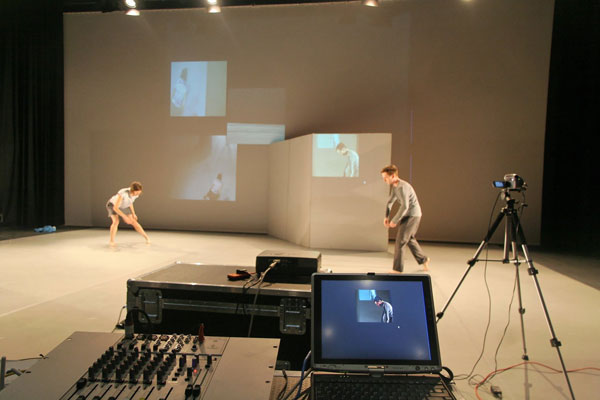
Helen Bailey uses e-Science to build co-located dance performances where their are dancers from multiple locations in a single dance arena (using video feeds). This research focusses on the synchronous capabilities of an HPC network to support multiple video feeds in order to assemble a real-time event.

Helen’s website: http://www.beds.ac.uk/departments/pae/staff/helen-bailey

Photo Credit: http://www.arts-humanities.net/system/files/images/edance.jpg

Delivering the Goods of Democracy for your VO

Crates1

One of the first conversations I have with people who have been tasked to build or manage a virtual organization centers on the cost/benefit issues of democratic governance. Given the usual shortage of funding and time, they have real concerns about the effort required to build a community-based governance system. These concerns are usually layered on top of the more general concern that the community (or rather, certain activists within the community) may use the governance system to push the organization’s goals toward their own interests.

Certainly, democratic governance increases the overhead (in terms of time and effort) spent on governance. Top-down decision making can be quite efficient up to the point where it tends to fail rather abruptly. Democratic governance is also more prone to being gamed by people with time and interest to do so. This is where the community comes in to play. When you build in enough democracy to give the community the opportunity to really govern, it will tend to resist the efforts of certain individuals to subvert this opportunity. This is one of the goods that democracy delivers to your VO. Continue reading “Delivering the Goods of Democracy for your VO”

Beware of Zombie Democracy in your VO

Zombie1

Some digital organizations want your enthusiasm, and will suck this dry with offers of representation and feedback. How do you know your interests are being represented when the social network (SN) or virtual organization (VO) sets up a feedback system? What if they create some kind of users committee? What if they ask you to vote? All of these look like democratic practices. But the real test comes when decisions are made. Remember that democracy is a form of governance. If your feedback form, vote, representative delegate has no authority within the governance system, it’s just a zombie practice. It looks vaguely like democracy from a distance.
Most VOs and SNs are RUN BY SOMEONE… someone with their own interests. Someone being paid to do so. And that someone is probably not you. If they conjure up some kind of democratic shell game, demand to know how decisions are being made and where the money goes. If they are honest and tell you they want your feedback because it’s valuable to them and it might help them serve you better–you know where you stand.

Photo Credit: Ateo Fiel on Flickr. used with CC atribution license

Questions Virtual Organizations don’t usually ask themselves

Questions1

What does it mean to be a “peer” in your peer-based organization? Who gets to initiate teleconferences? How are opinions and criticism handled? What active feedback do you collect? Who gets to see this? In what ways can your peers self-identify with your organization?

At the center of your project, PIs, Co PIs, and staff are tasked (and paid) to do work. How much extra (unpaid) work is required to actually move the project along?  How are the other people of the organization (advisory committees, workshop participants, developer community members) attached to the work of the core? Why should they contribute their time and expertise?

You’ve just gotten a multi-year grant to create a “community-based, collaborative” research VO. Do you know how to recognize “community” within the population you have targeted to collaborate in this effort? Do you know how much and what type of community is sufficient to support your “community-based” effort? If you need to build community, do you know how to do this and when to start?

Your cyberinfrastructure VO has a stated goal of creating a sustainable software service layer to support virtual collaboratories. You need to choose from among four possible software standards to start this effort. How do you make this choice? Why should the final user community agree with you?

photo credit: Timothy Volmer

They call you a Peer, but treat you like a Peon

Peer1

ANOTHER FAMILIAR SCENARIO: It’s one thing not to get paid, that’s part of the deal when you volunteer. You’re getting paid anyhow to work on the IT projects for which you’ve been contracted. If you work in a government lab, or a university, a non-profit, or a commercial lab, your own deliverables come first. In the world of IT, however, there’s always some reason to look outside your current project to the next project or the next technology that might leverage (or squash) your current work. So, you join the listserves and the professional societies and you pay close attention to the larger picture. That’s why you went to the workshop for this new project that is pushing the envelope on some piece of IT technology or standards close to your interests.

At the workshop you were invited to join the “distributed, community-based” research effort. Now there’s an email from someone you don’t remember asking if you can do this or that (can you evaluate the wording on this standard? can you join a teleconference next Thursday?) and you have to decide if the email gets trashed or answered.

When you volunteer to serve on a committee of a virtual organization (VO), your time is still valuable to you and your organization. The last thing you want to do is somebody else’s work for free.  What reasons did the VO give for asking you to participate? If you can’t remember, the email will go in the trash. Who made the decision to create this standard? If you can’t find out, the email will go in the trash. You don’t mind volunteering, but you need to know how your contribution will be considered and acknowledged. If your child’s school asked you to come over on the weekend to help paint the new computer lab, you’d expect the same.

If the virtual organization is going to call you a peer, they should mean this. If you are working among equals, you should have equal access to information about the decision making process and equal input into it’s practices. If they do the telling and you do the work, your volunteer enthusiasm won’t last long.

Adding another listserve, WIKI, or content management system to the mix just ups the overhead without answering the question: what does it mean to be a peer in this peer-based VO?

If the answer to this is not provided up front and then maintained with rigor, then your VO is under-governed and bound to shed volunteers like a tabby in May.

The Answer:

Before they invited you to come to the workshop, the VO should have set up a governance structure that gives you stature in the organization and information on demand. This doesn’t mean you can demand access to resources. You can’t just cut yourself in for a piece of the grant. But you should be able to follow how the advice you give, or the work you do is used by the core team, and you deserve attribution for your efforts.

All of this can be done through the software services the VO sets up for communication, and the democratic governance practices it adheres to when working with volunteers. Note: the VO might have other practices it uses to demand work from its paid core. Governance and project management practices work together but are not identical.

Picture source: http://www.gpwu.ac.jp/~biddle/new_pa7.jpg