Building Double-Loop Organizations for Member Engagement and Innovation

I’m going to explore the idea of “double-loop” governance, with some ideas and some suggestions as to why you might want to consider this form of governance as the heart of the physical or virtual organization (or network, or corporation) you plan to start or hope to change.

Below, you will discover how a double-loop governance scheme brings the values, the vision, and the underlying assumptions of an organization into an open and transparent decision cycle.  This decision process is characterized by distributed (shared) participation and control, free and informed choices, public testing of evaluations, and an ability to manage conflict on the surface of discussion threads.

Members in an organization with double-loop governance have the ability to redirect, refocus, and recommit to the values and the vision of their organization. Double-loop governance creates peers for a peer-to-peer network. Because of this, membership is well-defined, and provided with responsibilities and rewards.

Double-loop organizations tend towards meritocracies and value contributions over clout (or Klout). Because decision-making—to the level of deciding underlying assumptions—is distributed rather than top-down, double-loop organizations depend on double-loop learning (and Model II theories-in-use). Contributions to decisions and work toward goals (software code contributions, etc.) can be used to measure the value of members, and to reward their service.  The vectors for acquiring merit are ideally well-described and collectively fashioned. A great example of this is StackExchange (http://stackexchange.com). Clay Shirky, in a recent talk (available at http://archive.org/details/drupalconchi_day2_keynote_clay_shirky), describes how StackExchange uses double-loop governance to engage its members. Double-loop organizations are better able to discover and reward emergent leadership and harvest the long-tail of community participation.

Much of the added value of a double-loop governed organization comes from the quality of interpersonal interactions, the extra amount of available trust, and the additional flexibility that distributed decision making provides. This value does not arrive without additional costs (which are described below). For ventures that are designed to solve a single problem and then end, these costs may not be appropriate. But for enterprises that hope to grow and flourish in today’s changing IT landscape, these costs are essential to sustaining any organization.

While notions of double-loop governance apply to various organizations, here I want to focus on virtual organizations/internet communities. These have some common features. They are created to solve a problem or problems, often problems of some real consequence. They rely on the voluntary contributions of experts. And they bridge between groups that may have diverse or divergent interests. Examples of these organizations/communities of which I am somewhat familiar (either personally or through other sources) include the W3C, Ubuntu Linux, Stack Exchange, the Open Geospatial Consortium, the Federation of Earth Science Information Partners, the National Science Digital Library, and the Digital Library for Earth System Education.

Some of these organizations are/were more successful in their governance efforts than others. Some of these examples no longer exist, in part because of their governance choices. Other authors have pointed to Apple Computer, the Valve Corporation (entertainment software makers), and Zappos (online shoe store) as good examples of culture-led corporations that use double-loop learning to pivot to new opportunities; and these provide some lessons on how double-loop management/governance can become an integral feature of a for-profit organization. The Valve Corporation Handbook for New Employees, First Edition (2012) welcomes new employees with this statement: “The company is yours to steer—toward opportunities and away from risks. You have the power to green light projects. You have the power to ship products” (p. 4). In full double-loop mode, the Handbook is also editable by employees, new and old: “This book is on the intranet, so you can edit it. Once you’ve read it, help us make it better for other new people. Suggest new sections, or change the existing ones” (p. viii).

The various examples show how spending the time and effort to become a double-loop governed organization is important for innovation, for volunteer engagement, and for sustainability (i.e., the why of double-loop governance). What follows are some thoughts on where the value of double-loop governance is found, and how to boot-strap and support double-loop governance for a new virtual organization.

It could be argued that single loop organizations and management were well suited for a time when the pace of innovation was much slower than today. The single goal of becoming more efficient in, and creating sustaining technologies for, the manufacturing of, say, automobiles or washing machines could carry a corporation for several decades. The pace of innovation within information technology now means that organizations need a new ability. They need to pivot to respond to external (disruptive) innovations, and they need to rethink their underlying assumptions to stay creative and innovative internally. These capabilities belong to the second loop of a double-loop organization.

References

Double-Loop Learning as an outcome of Double-Loop Governance

The concepts of double-loop governance and double-loop learning (Argyris and Shön, 1978) share a common ground in the communicative acts required to support these. Double-loop governance puts into practice what Argyris calls a Model II style of theories-in-use. A Model I “theory-in-use” for Argyris (1982, 8) represents the set of assumptions that a person puts into everyday practice without reflection. A Model I theory-in-use greatly resembles what Pierre Bourdieu calls a individual habitus (1990, 56). What a Model II style adds is a critical reflective moment. A Model II style is characterized by valid information, free and informed choice, and internal commitment (Smith 2001). Model II supports double-loop learning: an ability to question an “organization’s underlying norms, policies and objectives.” (Argyris and Shön, 1978, 2-3; quoted in Smith 2001). This ability—which all nimble online organizations require to keep up with changing codes and capabilities—needs to be established as a cultural goal of the organization. And for this, it needs to be a visible part of the organization’s governance scheme.

This is what separates a double-loop governance effort from a single-loop governance structure linked to a management plan (or tied to a charismatic founder). “Governance is almost entirely based around values,” notes Jono Bacon (Bacon 2009), community manager for the Ubuntu distribution of Linux. “You need to not only understand your values, but celebrate them,” he concludes. In terms of double-loop governance, I would add that an organization needs to reflexively control (c.f., Giddens 1994: 122-123) its values, interrogate them regularly, and celebrate how robust they are. They are robust because there is an active process to reform and renew them as needed.

Single Loop Management

Organizational management provides at least a single loop of internal communication and learning. Goals, strategies and techniques are attempted and their outcomes evaluated. On the basis of this evaluation, new goals, strategies, and techniques are attempted. The desired outcome of the single loop is an improvement in efficiency. This is essential Twentieth Century business management guidance. How business was done.

This is also, in part, why so many Twentieth Century corporations are no longer here. Disruptive innovation and other rapid market changes cannot be addressed through efficiency alone. John Kao (2002) describes it this way, “We all want benchmarks to get the job done more efficiently. But this does not lead to disruptive, game-changing innovation, the stuff of which organizational renewal and competitiveness under conditions of uncertainty are all about.” (Kindle Locations 2686-2689).

Government agencies are also good examples of single-loop governed, problem-focused, service-delivery organizations. They work under externally mandated goals and priorities. Even their single-loop quest for greater efficiency is sometimes constrained by legislative demands and regulatory road-blocks. These constraints provide a motivation for for agencies to partner with double-loop virtual organizations where disruptive innovation capabilities can be built into the working culture and governance framework.

Clayton Christensen (2002) describes how the capability for innovation, and particularly for disruptive innovation, “…lies in the resources-processes-values (RPV) framework…” of an organization. (Kindle Locations 1962-1966). What Christensen found was that single-loop organizations (organizations that cannot reflectively question their underlying assumptions, values, and vision) create incremental, sustaining innovation that increasingly values high-margin results and high-budget customers. These organizations do not have the capability to pivot to take advantage of a disruptive innovation.

Double-loop organizations will have processes that resemble those of the single-loop organization (trial and error, experiment and review, etc.). Efficiency and linear, sustaining innovation for progress to a desired goal: these are not abandoned. But they are embedded in the larger discussion of their relative return on an investment in their outcomes based on a larger vision that includes disruptive innovation opportunities. All of the thousands of PPTs with arrows connecting the end of a process to its evaluation and then back to the start of the process can still be used: with some necessary modification. These must include another loop out to “review assumptions and rethink and reapply values”.

References

Double-Loop Organization Membership

The ESIP Federation Assembly meets every year to decide on a range of issues.

Double-Loop Organization Membership

Double-loop governed organizations place significant value on the rules and roles of membership. Whether the organization is a “purpose-led” corporation, such as Zappos, an open-source software community, such as Ubuntu, or a collection of research projects, such as the ESIP Federation: membership (or employee-ship) is important because members are tasked to create and celebrate the values and the vision of the organization and to work to fulfill its mission and goals. Members are inspired (rather than required) to commit to this vision. Membership is openly acquired and acknowledged, and its responsibilities are plainly spelled out. Somewhere in the shared rules and roles, an ability to rewrite the shared rules and roles is provided to all members.

This ability creates and supports a mode of reflexive learning. At the same time that members are working to solve certain problems—the solution for which is the mission of the organization—they are also evaluating this same mission. They are responsible not just for incremental success, but also for opportunities to pivot the entire organization into a different mission, one that resolves not just the problem at hand, but some underlying condition as well.

At Zappos, an internet shoe store (now a part of Amazon), employees in their first days of orientation are given the option of taking a $2,000 check to simply quit and walk away. “We want employees that believe in our long-term vision and want to be a part of our culture.”(Hsieh 2010; Kindle Location 2549). At winter ESIP Federation meetings all of the members present gather at Assembly meetings where fundamental issues (including the organization’s budget) and executive positions of the organization are brought up for discussion and a vote.


Single-loop organizations may also support membership, but membership for these is often perfunctory (e.g., a log-in account on the organization website), and may be loosely defined or changed without members having a say. The organization may simply use its membership as a list to broadcast (or request) information.

Here we might remember that the U.S. Government is (at least in spirit) a double-loop governed organization. Article 5 of the U.S. Constitution gives the Senate and/or the States a method to create a constitutional convention to rewrite the constitution. (After two hundred years since the first one, a constitutional convention would certainly produce some interesting new text.) A related power is given to amend the Constitution, a process that has been performed several times.

Similarly, Article 9 of the Constitution of the Federation of Earth Science Information Partners gives the membership the right to rewrite or amend its constitution. Because members can re-vision the organization, membership rules and roles are taken very seriously by the organization, and consequently, by its members. The governance charter of the Ubuntu organization provide precise rules and roles for managing that software development (See: http://www.ubuntu.com/project/about-ubuntu/governance ). Charters, statements of values, and constitutions are all indicators of double-loop governance, although the amount of double-loop capabilities rests in how much reflexive authority they give to the membership.

The vision statement, as Sinek reminds (2009) us, is the public statement about why an organization exists. Mission statements/business plans are Loop 1 outcomes. The mission statement tell us how the organization “intends to create [the] future” (Kindle Locations 2035-2045).  The “how” is firmly in Loop 1. This is further articulated in business and strategic plans, and then in policies that direct activities. The “why” lives in Loop 2, and is embodied in the values expressed through the vision statement. The why—the vision, expressed as values—is often described as the “culture” of the organization.

Tony Hsieh is famous for saying “your culture is your brand.” (2010, Kindle Locations 2529-2540). Your vision statement, including your core  values, is the center of your organization: “We believe that it’s really important to come up with core values that you can commit to. And by commit, we mean that you’re willing to hire and fire based on them.” (Ibid, Kindle Locations 2545-2566).  In a community-based organization, just as in a purpose-led company, double-loop governance—as difficult as this may be to bootstrap—forges a congruence between the words on the vision statement (whatever these are), and the quality of learning and knowledge management in the organization. When “your governance is your culture,” the members can more fully commit to the organization. This makes many subsequent (and consequent) tasks that much easier.

Done well, culture is not just an asset, it is an engine for double-loop learning within the organization, and that, in turn, is the foundation for knowledge management. Lehr and Rice (2002) make the following observation; “Double-loop learning is where knowledge is generated from information: more specifically, where the process of implementing information is evaluated, validated, verified, and adapted (p. 1062). Done poorly, “culture” becomes either decorative or punitive (something that employees are required to memorize, rather than something that could engage an active volunteer-base). Vision statements can and should be early Loop 2 outcomes. Single-loop organizations also have vision statements. What they lack is the built-in capability to question the underlying assumptions of these.

For a member/community-led organization the vision is what brings together all of the disparate intentions and backgrounds into one common, shared future. This vision should be visionary, it should announce with conviction the higher purpose that the organization will embrace (higher than profits or technological success). It needs to inspire the membership, and incite the impulse to leadership.

References

Building a Double Loop for Liquid Innovation

Building a Double Loop for Liquid Innovation

By relying on transparent decision processes, open information flows, and shared—and celebrated—values, double-loop governance can power a virtual organization to hold together large collections of otherwise independent, and even conflicting, groups (for- and not-for profit organizations, widely scattered science disciplines, suppliers and end users, etc.). They can also house large numbers of self-organizing subgroups, each one of these working teams (the ESIP Federation calls them “clusters”) is committed to specific action points.  This creates what Hagel and Brown (2011) call a “creation net” for open innovation within a virtual organization.

This creation network is enabled by a certain quality of learning within interactions, a greater quantity of information flows (and/or a greater attention to these), an availability of interpersonal trust (based on demonstrated skills and commitment), and an environment of reflexive involvement: all benefits of belonging to  a community-led double-loop governance. When members are given license to form working teams based on their own informed insights into where the adjacent possible is found, creative interactions and new knowledge become predictable outcomes.

The “adjacent possible” is a notion that comes from biological theories of coherent change. It describes how an environment between static and chaos provides a repertoire of available changes. Adjacency is a helpful way to describe how a virtual organization can use a combination of well-designed face-to-face meetings and Internet-based communication/collaboration technologies to create the spaces where, as Matt Ridley (http://www.rationaloptimist.com/home) calls it, “ideas go to have sex.”  If you can point to your organization and truthfully say: “this is where ideas go to have sex,” (or something like that), then you’ve built a place where the idea makers among your members will be happiest and most creative.

Steven Johnson, <http://www.ted.com/speakers/steven_johnson.html>, uses the metaphor of “liquid” to describe the optimal network environment to enable innovation (Johnson, 2011). “Solid” networks are too stiff to pivot toward “the adjacent possible” where new ideas sprout. “Gas” networks are too chaotic. “In a solid, the opposite happens: the patterns have stability, but they are incapable of change. But a liquid network creates a more promising environment for the system to explore the adjacent possible. “ (Kindle Locations 611-614).

More specifically, liquid networks—and the virtual organizations that create these—enable individual members to explore the adjacent possible; “When the first market towns emerged in Italy, they didn’t magically create some higher-level group consciousness. They simply widened the pool of minds that could come up with and share good ideas. This is not the wisdom of the crowd, but the wisdom of someone in the crowd. It’s not that the network itself is smart; it’s that the individuals get smarter because they’re connected to the network.” (Ibid, Kindle Locations 677-680). The liquid network is another way of talking about network diversity, the optimal mix of strong ties, weak ties, and strangers in direct communication (See: Ruef, 2002) that is a strong predictor for innovation.

References

Volunteer Engagement in your Double-Loop Organization

Lamp lighters at Burning Man. Burning Man requires 2000 volunteers (Chen 2009)—almost all of whom also buy tickets and pay their own expenses—to run Black Rock City.Photo by Trey Ratcliff. CC licensed. http://www.stuckincustoms.com/

Volunteer Engagement in your Double-Loop Organization

How does double-loop governance help engage volunteers? What is different about the “culture” of a double-loop organization, how does this difference matter to volunteers?


Community-led virtual organizations work every day to engage volunteers and develop leadership from the member community.  There is no governance solution that can put this process on autopilot. The loss of commitment by volunteers was reported in more than seventy-seven percent of narratives about the failure of non-profit organizations (Duckles, Hager, and Galaskiewicz, 2005, p. 190). To use a nautical metaphor, we can say that member investment in the values and the vision of the organization is like a tail wind, and double-loop governance is a spinnaker that catches this. Extending this metaphor, the staff still needs to keep rowing, and someone needs to hold the rudder. But a lot of valuable velocity is acquired by capturing member investment.

Malone, Laubacher, and Dellarocas (2009) describe three elemental motivations for participation in an organization: money, love, and glory. In virtual organizations that rely on volunteer experts, the “money” motivation is specifically unavailable. In fact these experts often have full-time work elsewhere. Love and glory are the two remaining sources of the motivation for investment by members.

Above, we noted that double-loop organizations base their governance on values that are owned, shared, and celebrated by its members. While members may not totally love these values, the fact that they own them and cherish them, celebrate them regularly, and modify them with care is as close to love as any organization can accomplish.  By supporting meritocracy, the double-loop organization opens an arena for glory. How effectively this arena is articulated will impact the success of the organization. Leadership needs to be cultivated, captured, and recognized. Much of the work of a large double-loop organization may be done in self-organizing subgroups, and so some transparent process to recognize this work needs to become an integral aspect of how the larger organization, and the entire membership community, measures value.

Single-loop organizations also attempt to capitalize on love and glory. Reputation systems and “communities of practice” can be added to any organization. Social media savvy online stores such as Amazon and eBay have built strong reputation systems for sellers and reviewers. Premier reviewers can see their reviews show up at the top of lists. Airline and hotel companies build “loyalty” (a substitute for “love”) by offering rewards for repeat purchases. But for volunteer-based organizations, these interactions fail to produce the level of member investment that a double-loop organization can provide.  That investment is time and talent they give to your collective goals. It is a resource that most budgets cannot buy. Double-loop governance gives your member community good reasons to trust the efforts of your staff, to contribute to governance tasks, and to care for your vision and your values.

References

Risks and Costs of Double-Loop Governance for Your Organization

Yes, you will be giving all your members the power to steer. Image from the Valve New Employee Manual.

Risks and Costs of Double-Loop Governance for Your Organization

There are real costs and real risks in choosing a double-loop governance scheme. Single-loop, top-down management is significantly more efficient in the short run. Funders may expect a management plan that spells out a hierarchy of communication and responsibility. And, if your organization does not need or want to sustain itself for more than a couple years, then double-loop management may be a wrong decision. But if you are looking to build a virtual organization that has a good chance to be sustained for years or decades through community effort (including downstream fund development) and a small staff, then an initial investment in double-loop governance is key. You will need to sell this to your funders as an investment in sustainability.

From the perspective of the founders, the main risks in implementing double-loop governance comes from the ability of the community to alter the founder’s vision for the organization. Double-loop governance lets everybody steer. This means that the direction travelled will happen through a rough consensus. It also means that the vehicle can move rapidly to another direction once everyone is on board with the new vision.

When decisions are owned by the community, the community will express its own vision. Bacon (2009) has some recommendations for start-up community leadership that can provide some added stability to the initial vision during the boot-strapping period. But the final word will belong to the community. If you are building an organization and cannot let go of your own vision of its future and goals, then build it with a single-loop management, and trust that you have enough charisma to hold it together. Otherwise, offer the vision to your members and give them the tools to make this something they can celebrate.

In terms of cost, the main obstacle to double-loop governance is time. It will take additional months of discussion to arrive at a rough consensus about the governance system documents. (ESIP Federation members worked constantly for more than two years to arrive at their final first draft of a constitution and bylaws.) And it will take additional time for subsequent decisions to be vetted by the community before they can be implemented. Transparent decision making also means giving time for member feedback. Fortunately, much of the business plan implementation efforts can be distributed into subgroups which can be given enough self-governance to streamline their decisions and to accomplish work on specific action points in an agile fashion. This is how major open source software efforts are currently organized.

Staffing a double-loop governed organization requires finding people who have enough patience to stick to the processes that have been decided by the community. They also need to resign themselves to the basic idea that each member is also their boss: all members have the right to comment on the ongoing workings of the organization.  Then again, it’s also the case that members have an obligation to recognize the good work of the staff.

References

Bootstrapping the Double-Loop Governed Organization

Ready to blaze the trail for your organization? Photo by PixelPlacebo on Flickr. CC licensed.


So, you want to start a new virtual organization. Perhaps you have been awarded some funds to do so. Here are Seven Key Suggestions.

First Suggestion: Read Jono Bacon’s The Art of Community. Bacon has more good advice than you will find in a hundred blogs. Governance is not the same thing as management. “Don’t fall into the trap of assuming that governance is merely about decision-making. There is no reason why you can’t constrict it in this way, but you will be missing out on a wealth of opportunities to excite and energize your community.” (Bacon, 219). What Bacon will also tell you, and it’s very important, is that you need to build your community and its governance first thing. This is not a “phase 2” activity in any plan.

Second Suggestion: Connect with the community on the issue of membership. Who gets it, what levels there are, who gets to vote, who gets to lead, and how to manage conflicts: getting some early conversations done with the community, and particularly those who will be asked to volunteer, will help to draft that part of the initial governing documents. Remember that you are setting up the initial conditions for your member-led organization. Double-loop governance means that your members will be able to rethink membership rules and roles.

Third Suggestion: No matter how much you want to implement a plan with your team, and no matter how you have researched effective governance, you will only be creating a temporary framework for your membership to use as a first go-around for a governance system. Because you are giving your members the ability to make changes in the documents you have drafted , you have to understand this: they will make changes, probably right away before even an initial vote is taken. And then remember: this is a good thing. So, put the texts up on a wiki and let them have a go at it. The sooner they come to own the text, the sooner they will start to celebrate its vision.

Fourth Suggestion: Put some budget into play if you have this, but not to pay volunteers for their time (Here is some advice about money and volunteers: https://cybersocialstructure.org/2011/08/10/staffandvolunteers/). Help support communication, pay for students to do some background research for a draft business plan (the “how” of your organization), bring in some key community members for a workshop, but open this up through video conferencing, and support some others who express and interest to also be present.

Fifth Suggestion: Always work toward a rough consensus, and never erase “minority reports.” Let conflicts rise to the surface and deal with them quickly. Leave their content open for others to see. Show your members that their time, their skills, and their opinions are honored, even if they are overruled. Jono Bacon has great advice for conflict resolution.

Sixth Suggestion: Ignite some preliminary teamwork by having the initial community vote on two or three small, “low hanging fruit” efforts and then support ad hoc teams (clusters) to address these. By this you begin to show an initial innovation ROI the virtual organization will build upon.

Seventh Suggestion: Hold face-to-face meetings, but keep them from being PPT centric. Plan for small-group discussions and multiple breakouts, and hold the meetings in convivial neighborhoods, not airport hotels. Gather as many members as are there and read over the founding governance documents paragraph by paragraph (but only once, and then set up a process to edit the text online until the document goes up for a final vote), and let the group speak their concerns. Open up the entire budget for the membership to give their suggestions. If possible, let the membership vote on the budget after suggestions have been taken and changes made (a real vote).

These suggestions are just a starting point for boot-strapping a double-loop governed virtual organization. Once the hard work of building in double-loop governance into the culture of the organization is over, the rewarding work of seeing how this accelerates volunteer engagement can begin, and the creative work of husbanding this engagement into your organization’s business and strategic goals can be fully supported through the culture and the values, and the celebrated vision you own as a community.

Walking the walk is only hard when you haven’t tried it

For many organizations, the rush to market and the lure of some short-term exit strategy might make all this focus on congruence and culture and values and vision seem superfluous. And if your goal is to start-up and sell your business in the next 24 months, you would be wise to stick to a single-loop management plan (with a hefty stock option, because you will not have much love or glory). But if you are tasked to build a virtual organization that can stand on its community-based resources, you should seriously consider building in double-loop governance from day one.  What you are offering your membership (or your employees, or your customers) is a congruent experience: whatever your brand (or your vision) will become, it will emerge directly from your culture. When you put double-loop governance at the heart of your organization, you might want to stand back. Because ideas will definitely be having sex here.


References

Double-Loop Governance References

Anderson, L.  (1997) Argyris and Schon’s theory on congruence and learning [On line].  Available at http://www.uq.net.au/action_research/arp/argyris.html .

Argyris, C., & Schön, D. (1978) Organizational learning: A theory of action perspective, Reading, Mass: Addison Wesley.

Bacon, Jono. (2009) The Art of Community: Building the New Age of Participation. Sebastapol:OʼReilly. Available at: http://www.artofcommunityonline.org/downloads/jonobacon-theartofcommunity-1ed.pdf .

Bourdieu, Pierre (1990) The Logic of Practice. Stanford: Stanford University Press. [Originally Le Sens Practique Paris: Éditions de Minuit. 1980.]

Chen, Katherine K. (2009) Enabling Creative Chaos: The Organization Behind the Burning Man Event. Chicago: University of Chicago Press. Kindle Edition.

Christensen, Clayton M. (2002) “Coping with Your Organization’s Innovation Capabilities.” In Frances Hesselbein; Marshall Goldsmith; Iain Somerville. Leading for Innovation: And Organizing For Results. Kindle Edition. Originally published by Josey-Bass: New York.

Duckles, Beth M., Mark A. Hager, and Joseph Galaskiewicz (2005) “How Nonprofits Close: Using Narratives to Study Organizational Processes.” Pp. 169-203 in Qualitative Organizational Research: Best Papers from the Davis Conference on Qualitative Research, ed. Kimberly D. Elsbach. Greenwich, CT: Information Age Publishing.

Giddens, Anthony. (1994) Beyond Left and Right: The Future of Radical Politics. Stanford: Stanford University Press.

Hsieh, Tony (2010-05-20). Delivering Happiness: A Path to Profits, Passion, and Purpose. Hachette Book Group. Kindle Edition.

Johnson, Steven (2011-10-04). Where Good Ideas Come From: The Natural History of Innovation. Penguin Group. Kindle Edition.

Kao, John. (2002) “Reinventing Innovation: A Perspective from The Idea Factory.” In Frances Hesselbein; Marshall Goldsmith; Iain Somerville. Leading for Innovation: And Organizing For Results. Kindle Edition. Originally published by Josey-Bass: New York.

Hagel, John III and John Seely Brown (2008) “Creation Nets: Harnessing The Potential Of Open Innovation” Journal of Service Science. Vol. 1. No 2. Pp. 27-40.

Lehr, Jennifer K. and Ronald E. Rice (2002) “Organizational Measures as a Form of Knowledge Management: A Multitheoretic, Communication-Based Exploration. Journal of the American Society for Information Science and Technology. 53:12. Pp. 1060-1073.

Malone, Thomas W., Laubacher, Robert and Dellarocas, Chrysanthos N., Harnessing Crowds: Mapping the Genome of Collective Intelligence (February 3, 2009). MIT Sloan Research Paper No. 4732-09. Available at SSRN: http://ssrn.com/abstract=1381502 .

Ruef, Martin (2002) “Strong ties, weak ties, and islands: structural and cultural predictors of organizational innovation.” Industrial and Corporate Change, Volume 11, Number 3, pp. 427–449.

Sinek, Simon (2009-09-23). Start with Why: How Great Leaders Inspire Everyone to Take Action. Penguin Group. Kindle Edition.

Smith, M. K. (2001) “Chris Argyris: theories of action, double-loop learning and organizational learning,” the encyclopedia of informal education, http://www.infed.org/thinkers/argyris.htm. Last update: December 01, 2011.

Valve Corporation Handbook for New Employees. (2012) Kirkwood: Valve Press. Available on the Internet on April 22, 2012 at: http://newcdn.flamehaus.com/Valve_Handbook_LowRes.pdf .

Acknowledgements: I want to thank Erin Robinson for her insights on an early draft.

Earth Cube as a Double Loop organization

I’ve been listening in on the opening discussions at the Earth Cube governance meeting, and I’m impressed by the level of passion and amount of expertise at the table. I’m also interested in how the conversations seem to whiplash from notions of democracy and community to ideas for data standards. People have come to the table with divergent notions of what governance means, although they are also aware that governance can mean both democracy and data standards. I would like to argue that they are looking at the same organization, but they are each describing only one of the governance “loops” that will be needed for Earth Cube.

Take a look at this Keynote talk by Clay Shirky (DrupalCon 2011)

http://archive.org/details/drupalconchi_day2_keynote_clay_shirky

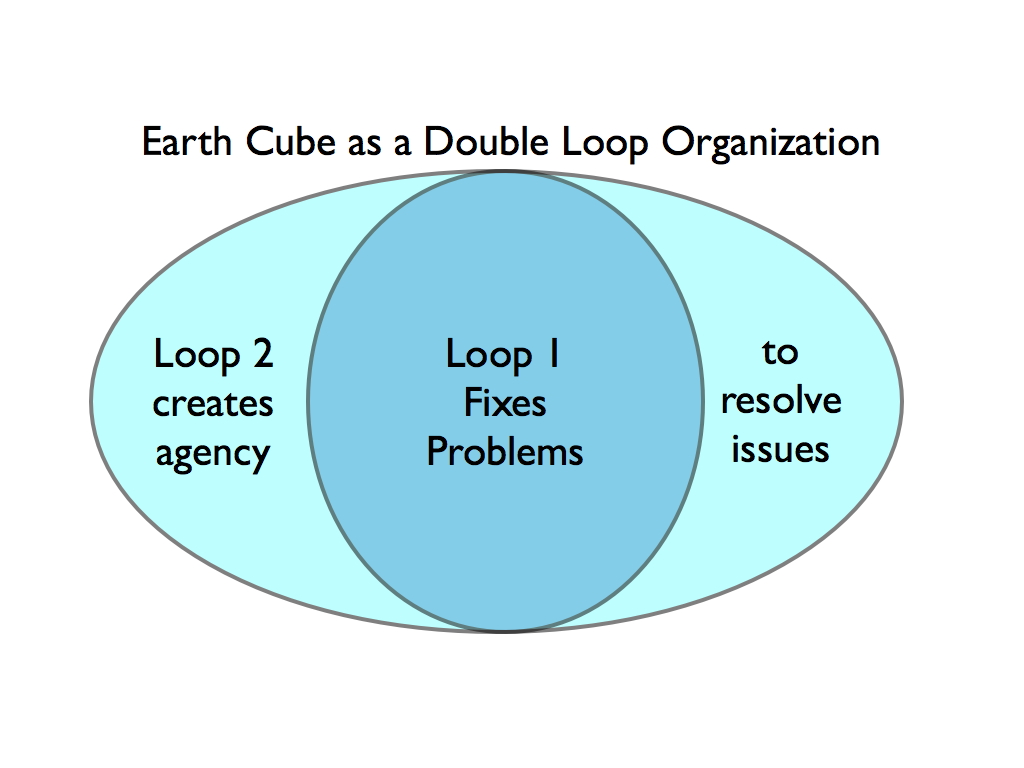
about 45 minutes into the video Clay is talking about organizations that not only fix problems, but that simultaneously can solve the larger issues that created the problems. In these “double-loop” organizations, the members agree to governance rules that solve common problems for their interactions (e.g., data sharing). At the same time, they agree to own these rules, that is, to govern their governance system. And so, when someone talks about building community, protecting expressive capabilities, voting, officers, and working consensus, constitution and bylaws, vision statements and goals: they are approaching Earth Cube governance from the second loop. This is where the members of Earth Cube agree to be its owners. And when someone talks about data sharing policies (enforcement, compliance, standards, etc.) for Earth Cube, they are also bringing to the table issues integral to governance. These are the activities, the goals, and the outcomes of Earth Cube as a distributed/virtual organization.

First loop governance fixes problems for the Earth Cube member community. Second loop governance creates what sociologists call “agency.” This agency is the ability/capability to govern how the community will fix its problems. Does there need to be a committee? Who gets to be on the committee? Who is involved in a decision? Who do you talk to if you feel your voice has not been heard? Second-loop governance is responsible to answer all of these questions. In a typical NSF project, this is called “management.” PI and Co-PIs are charged to create and implement an effective management plan. But who should create and implement an effective second-loop governance plan? The current vision for Earth Cube puts the community into this role. Members of the community are stepping up to guide this process. But a much larger community-wide conversation will need to happen before any second-loop governance plan can be implemented.

What about first-loop governance planning? When should this happen, and how? Initial discussions about the scope of the problems to be fixed and the solution spaces for these fixes will help articulate the amount of (loop-one) governance activities needed to effect the fixes. The model that emerges will guide the second-loop governance planners to better solutions for their level of governance. For example, if community buy-in to a strict set of data standards is needed, then the second-loop governance effort will need to plan to build a strong community. If the main requirement is better communication, then a much weaker community will suffice.  But again, these discussions will need to be revisited after the second-loop governance effort is agreed to by the members. So the governance boot-strapping process will resonate between the two loops until the initial governance plan is accepted by the Earth Cube members. At that point, the second-loop governance is empowered to address new fixes, and to fix itself whenever this is needed.

A good example of this can be found in the history of the ESIP Federation. The Federation spent more than two years, and included direct participation by several dozen members before it finalized its constitution and bylaws (the main second-loop outcome). When the final vote was taken, and these documents were accepted by consensus, then the various committees, and emergent working groups and thematic “clusters” were supported to begin to fix problems faced by Federation members: data interoperability and stewardship being chief among these.

Building a governance model for Earth Cube will require looking into both loops: the first loop describes a number of fixes planned to address common problems (mainly around data use and sharing), while the second loop describes how the Earth Cube community can acquire ownership for the decision processes to determine which fixes are most important, and how to engage the broader community in their implementation.

Community Engagement: your agency does not have the budget to not support this

Funded research that includes a charge to engage a community (of scholars, end users, students, etc.) in doing this research, or in using its products (data, metadata, standards, etc.) is usually underfunded. There are two simple reasons for this. The first reason is that agencies typically underestimate the cost of doing community engagement through community governance. The second is that money is a very poor instrument for directly accomplishing engagement, mainly because of the perverse effects this has on volunteerism.

At the same time, efforts to support “community” are often pursued without actually building community-based governance. Project budgets may include large amounts of “participant support” for annual “community meetings” that could help build engagement. But without the governance structure that puts the community in a position to determine key aspects of the core activities, these meetings are really only very expensive alternatives to an email list. The attendees may learn something, and will forge their own interpersonal connections, but the work of building community through governance is left undone.

I was once “voted” onto the policy committee of a large agency-funded effort. The first thing we were told, after they flew us in to the annual “community” meeting, was that the committee did not make policies. Similarly, the act of voting was used without any available model of membership. There are better ways to get the community engaged.

One of the reasons that community engagement has become more visible as a goal is the realization that “network effects” can greatly amplify the impacts of a research project’s outcomes.  Indeed, Metcalfe’s Law tells us that value of a network is proportional to the square of the number of members (n2). Bringing network effects to research collaboratories can accelerate communication of ideas and knowledge sharing. A more recent study by David Reed points to an even larger effect: that of group-forming networks. Networks that allow members to self select into smaller groups (clusters) approach an exponential increase in the scale of interactions (2n), a scale that grows much faster than any power law distribution. Enabling the network to create internal, purposeful subgroups where members are highly engaged is one strategy that can really pay off for a funded research project.

The two curves in these graphs are familiar to most. The top one is the “power law” curve, which describes many distributions, notably, the expected relationship between the amount of attention/activity on an open Internet network in relation to the number of people so engaged. This is the usual “10% of the members do 90% of the work” situation. The bottom curve is the “bell curve” normal distribution, where the main mode is high-activity. What is important to notice here is that the space under the normal curve is much larger than the space under the power law curve. Much more activity is happening here, even if the number of people are the same.

The use of community-led governance to foster engagement is covered in several other posts on this site. There are some real examples of this that can be studied. The Federation of Earth Science Information Partners (ESIPfed.org) is one.  I would guess that many agency program managers can point to histories of counter examples: of projects that never created any governance capabilities, even while they spend huge amounts of budget on “community.”

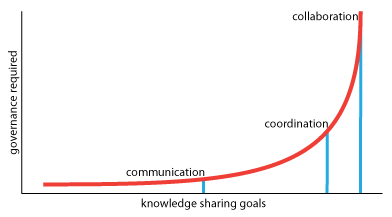
The amount of real governance required to support activities also depends on what types of activities need to be supported. If communication is the goal, then a relatively weak governance system will suffice. If real collaborations (those purposeful subgroups) are to be supported, then a robust governance system may be needed. Clay Shirky examines three levels of social interaction: communication, coordination, and collaboration. Each of these levels needs its own type of governance.

Distributing activities across an engaged volunteer network of peers can use a very limited budget to accomplish everything that needs to be done. Money is not the driving force here. It is rarely the case that agencies cannot afford to support governance through project research budgets; more to the point, they cannot afford to not support this if they want to accomplish what only a community can do.