

Santa Barbara Needs a Street Painting City Code Section

THE STORY OF SANTA BARBARA’S STREET PAINTING CODE
How a Neighborhood Transforms Its Street: A Narrative Guide
Imagine you live on a quiet residential street in Santa Barbara. You’ve noticed how neighbors rarely interact, how cars speed through a bit too fast, and how the intersection at the end of your block feels cold and uninviting. Then you learn about street painting — the practice of transforming ordinary asphalt into vibrant community art — and you wonder: could we do this here?
This is the story of how Santa Barbara’s proposed street painting code would work, told through the journey of a neighborhood project from conception to celebration.
CAVEAT: I am embarrassed, and a bit amazed that Claude AI used my prompts to create this text, which is very much what I wanted to say here. I’m sorry (well, maybe not) that this took one hour instead of a couple days.
Chapter 1: The Dream Begins
It starts with an idea. Most likely you saw how they painted State Street, or a photo of a painted intersection in another city, or read about Portland’s famous community street paintings. You envision a colorful mandala at your intersection, or perhaps a garden scene that makes drivers slow down and smile. This is where Section 22.60.050 Part A comes in — the code’s statement of purpose. The City recognizes that street painting isn’t just art; it’s “community expression, placemaking, and traffic calming.” Your dream aligns with the City’s vision.
But before you grab a paintbrush, you need to understand what you’re proposing. Part B defines the terms: an “intersection painting” covers the area within the crosswalks at all four corners, while a “mid-block painting” sits between intersections. And crucially, you can’t use just any paint — “approved paint” must meet California’s slip resistance standards, ensuring pedestrians won’t slip when it rains.

Chapter 2: Is Your Street Eligible?
Not every street can become a canvas. Part D lays out the eligibility criteria, and it reads like a checklist for finding the perfect location. Your street must be a “local residential street” — think quiet neighborhood roads, not busy thoroughfares. The traffic counters come out: if you want to paint an intersection, fewer than 3,000 vehicles should pass through daily. For a mid-block painting, the limit is 2,500 vehicles.
You walk your street with fresh eyes. No bus routes rumble past — check. The fire department hasn’t designated it as a primary emergency route — check. The pavement is smooth, without major cracks, and according to public works, it’s not scheduled for repaving anytime soon — check. Your street qualifies. The dream is still alive.

Chapter 3: Building Community Support
Here’s where the project becomes truly communal. Part E requires you to knock on doors and have conversations. You need written consent from 75% of your neighbors — not just a simple majority, but a strong supermajority. For an intersection painting, you need signatures from properties on all four sides.
You spend weeks talking to neighbors. Mrs. Rodriguez on the corner loves the idea and volunteers to help paint. The young family with kids thinks it will make the street safer. Mr. Chen is skeptical at first but warms up when you show him pictures from other cities. Slowly, the signatures accumulate. The project is building momentum, and something magical is happening: neighbors who barely knew each other are now planning something together.
Chapter 4: The Design Takes Shape
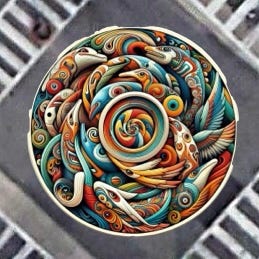
With community support secured, you move to the creative phase. Part F governs design standards, and it’s a balance between artistic freedom and practical safety. You gather a group of neighbors for design sessions. Someone suggests a sunburst pattern. Another proposes incorporating native California plants. A local artist offers to help create the rendering.
But there are rules. Existing traffic control markings — stop bars, crosswalks, lane lines — must remain visible. You can paint around them or incorporate them into the design, but drivers must still see them clearly. No commercial logos, no political messages, nothing that could be mistaken for an official traffic sign. The design must be visible but not so reflective that it creates glare. And if your painting includes crosswalks, it must maintain those tactile warning surfaces for people with visual impairments — the ADA compliance requirement.
Your group settles on a beautiful geometric design featuring blues and yellows that evoke Santa Barbara’s ocean and sunshine, with native wildflowers adorning the corners. The stop bars will be freshly painted in bright white over the design.

Chapter 5: The Paper Trail
Now comes Part C: the two-permit system. You need an “encroachment permit” because, technically, your painting is a structure in the public right-of-way — something that will remain in place. You also need a “temporary street closure permit” because you’ll need to close the street while painting.
Part E details what goes into your application packet: your detailed design drawings with precise dimensions, that stack of neighbor signatures you collected, a traffic management plan showing how cars will detour around your closed blocks, documentation that your chosen paints meet slip-resistance standards, a maintenance plan promising to keep the painting fresh, and proof of liability insurance.
You submit everything to the Public Works Director. The waiting begins.

Chapter 6: Paint Selection and Preparation
While your application is under review, you tackle Part G: paint requirements. This isn’t a trip to the hardware store for regular latex paint. You need specialized products — water-based, low-VOC paints with slip-resistance additives that meet California Department of Transportation standards. The Public Works Director maintains an approved list, and you order from these specific products. They’re more expensive than house paint, but they’re designed for exactly this purpose: outdoor durability and pedestrian safety.
You organize a fundraiser. Neighbors chip in. A local business makes a donation. The paint order is placed.

Chapter 7: The Big Weekend
Your permits are approved! Part H grants you up to 16 hours within a single week for your intersection painting — double the usual 8-hour block party limit because painting an intersection is a bigger job. You can spread these hours over multiple days, so you plan for two eight-hour days: Saturday and Sunday.
Part I governs the actual installation. Friday evening, you and a crew of volunteers install the barricades and cones according to your approved traffic management plan. Signs go up: “Street Closed for Community Painting Project.” But crucially, one lane remains open as an alternate route — emergency vehicles must always have access.
Saturday morning arrives with perfect weather — sunny, above 50°F, and no rain forecast for the next 24 hours (Part I.5). The street has been swept clean. An adult supervisor is always present as neighbors come and go throughout the day. Kids paint alongside their parents. Teenagers handle the detailed work. Someone brings a cooler of lemonade. Music plays. What started as a street painting project has become a neighborhood festival.
By Sunday afternoon, the intersection is transformed. Where there was once drab gray asphalt, there’s now a burst of color and community pride.

Chapter 8: Living with Your Creation
The paint dries. The barricades come down. Cars return, but something has changed — drivers slow down to admire the artwork. Pedestrians pause to take photos. Part J now governs the life of your street painting.
You and your neighbors — those who signed the consent forms — are jointly responsible for maintenance. The painting looks vibrant now, but Part J.2 reminds you that it will need refreshing every 1–2 years. You form a small committee. Someone sets up a neighborhood fund for future paint purchases.
Two years pass. The painting has weathered well, but some areas are fading. Part K allows you to renew your permit for another 24-month term. This time you only need 51% neighbor support (instead of the original 75%), and almost everyone signs immediately. The street painting has become a beloved neighborhood landmark.

Chapter 9: When Reality Intrudes
Year three brings a challenge. The water department discovers a pipe that needs replacing — right under your beautiful intersection. They have to dig it up. Part J.4 is clear: when the City needs to perform street maintenance or utility work, they’re not obligated to restore your painting. The backhoe comes. Your artwork is destroyed.
It’s disappointing, but the code anticipated this. After the utility work is complete and the street is repaved, you can reapply to repaint. The neighborhood rallies again. This time the process is faster — you know the ropes. Within three months, an even more beautiful version emerges, incorporating lessons learned from the first painting.

Chapter 10: The Bigger Picture
Part N hints at something larger: your street painting project might coordinate with other City initiatives. The Public Works Director mentions that your intersection is part of a Safe Routes to School study. Your traffic-calming art aligns with the City’s Vision Zero safety goals. Suddenly your neighborhood project is part of a citywide movement.
Other neighborhoods hear about your success. They start their own street painting projects. Within a few years, Santa Barbara has two dozen painted intersections, each reflecting its neighborhood’s unique character. The code you helped pilot has transformed how the City thinks about streets — not just as transportation corridors, but as public spaces for community expression.
Epilogue: The Fee Waiver
One detail you appreciated from the beginning: Part L.2 allowed the Public Works Director to waive or reduce fees for “neighborhood-organized, non-commercial street painting projects that demonstrate significant community participation and benefit.” Your project qualified. The City recognized that you weren’t trying to make money or advertise anything — you were building community. The fees were minimal, making the project accessible to any neighborhood with a dream.
The Moral of the Story
This code tells a story about what’s possible when regulations enable rather than prohibit. It’s not a story about bureaucratic red tape, but about a legal framework that says “yes, and…” to community creativity. Yes, you can paint your street, AND here’s how to do it safely. Yes, neighbors can transform public space, AND the City will ensure it doesn’t compromise traffic safety or create liability issues.
The code protects everyone: the artists, the neighbors, the pedestrians, the drivers, the City, and the future maintenance workers who need slip-resistant surfaces. It sets standards high enough to ensure quality and safety, but not so high that ordinary neighborhoods can’t participate.
Most importantly, it recognizes that streets are more than infrastructure — they’re community spaces. And when communities are empowered to make those spaces beautiful, something magical happens: neighbors connect, children play more safely, drivers slow down, and a simple intersection becomes a landmark that defines a neighborhood’s identity.
That’s the story Santa Barbara’s street painting code would tell — a story where creativity, safety, and community come together on the canvas of our shared public streets.
Note: This code section is modeled after Portland, Oregon’s street painting program requirements and adapted for Santa Barbara’s administrative structure, California regulations, and community needs.
DRAFT STREET CLOSURE EXAMPLE CITY CODE
Santa Barbara Municipal Code: This allows you to close a street. We just added Block Parties as a new reason to close a street.
A Formatted version of this code CLICK HERE.
Santa Barbara Municipal Code
Chapter 22.60 — STREETS AND SIDEWALKS
Section 22.60.045 — Temporary Street Closures
The Public Works Director may close or by permit allow to be closed temporarily any street or portion thereof for the following reasons:
A. Construction and Installation Activities
To facilitate construction, demolition, or installation of facilities on public or private property.
B. Street Protection
To restrict vehicular use of an unimproved street for the protection of the public or to eliminate a neighborhood nuisance.
C. Block Parties
To provide for neighborhood block parties, allowing residents to gather and celebrate community within their residential areas.
D. Community Events
To provide for community events, festivals, farmers markets, and public gatherings that serve the community interest.
E. Filming and Productions
To accommodate film production, commercial photography, or similar activities requiring temporary exclusive use of street areas.
F. Athletic Events
To facilitate organized athletic events, including but not limited to races, walks, cycling events, and similar activities.
Permit Requirements
All temporary street closures authorized under this Section shall include the requirements of the Public Works Director and shall provide for:
Insurance Coverage: Appropriate liability insurance as required by the Public Works Director protecting the public and the City from claims arising from the closure or event.
Traffic Control Plan: A traffic management plan approved by the Public Works Director that addresses:
Detour routes for through traffic
Access for emergency vehicles
Notification to affected residents and businesses
Placement of barricades and signage
Duration Limits: Specification of the duration of the closure, which shall not exceed:
Block parties: 8 consecutive hours
Community events: As determined by the Public Works Director based on the nature and scope of the event
Construction activities: As necessary to complete the work safely
Advance Notice Requirements:
Block parties: Minimum 14 days advance notice; written consent from 75% of households on the affected block
Community events: Minimum 30 days advance notice for events affecting arterial streets; 14 days for local streets
Emergency construction: Immediate closure permitted with notification to the Public Works Director within 2 business hours
Notification Procedures: The permittee shall be responsible for notifying all affected residents, businesses, and property owners at least 72 hours prior to the closure, except in emergency situations.
Restoration Requirements: The permittee shall restore the street area to its original condition immediately following the event, including removal of all barriers, signage, and debris.
Indemnification: The permittee shall indemnify, defend, and hold harmless the City and its officers, employees, and agents from all claims, damages, losses, and expenses arising from the permitted street closure.
Block Party Specific Provisions
For block parties authorized under Subsection C above:
Eligible Streets: Block parties may only be permitted on local residential streets. Arterial streets, collector streets, and streets designated as emergency access routes are not eligible for block party closures.
Frequency: No more than two block party permits per calendar year shall be issued for the same street segment.
Emergency Access: At least one lane must remain accessible for emergency vehicle access at all times, or alternative emergency access routes must be approved by the Fire Chief.
Alcohol: Any service or consumption of alcoholic beverages must comply with California ABC laws and City ordinances.
Amplified Sound: Any amplified sound must comply with City noise ordinances and shall cease by 9:00 PM.
Fees: Block party permit fees shall be established by resolution of the City Council and listed in the City’s Master Fee Schedule.
Authority and Enforcement
The Public Works Director is authorized to:
Establish administrative rules and application procedures for temporary street closures
Deny permits that would create unsafe conditions or unreasonably interfere with public use
Impose additional conditions as necessary to protect public health, safety, and welfare
Revoke permits for non-compliance with permit conditions
Coordinate with the Police Department, Fire Department, and other City departments as necessary
Exemptions
The following activities are exempt from the permit requirements of this Section:
Street closures by the City for public works projects or maintenance
Emergency closures by law enforcement or fire personnel for public safety
Funeral processions conducted in accordance with state law
Closures authorized by separate City ordinances or resolutions for recurring annual events
Note: This proposed code section is modeled after Portland, Oregon City Code Section 17.24.017 and adapted for Santa Barbara’s administrative structure and community needs.
NOW THE STREET CAN BE CLOSED
NEXT YOU GET TO PAINT!
DRAFT STREET PAINTING PERMIT CITY CODE
Santa Barbara Municipal Code: This specifies street painting regulations.
A FORMATTED VERSION OF THIS CODE CLICK HERE
DRAFT EXAMPLE CODE
Santa Barbara Municipal Code
Chapter 22.60 — STREETS AND SIDEWALKS
Section 22.60.050 — Street Painting Projects
A. Purpose and Intent
The purpose of this Section is to allow neighborhood residents to create artistic street paintings as a form of community expression, placemaking, and traffic calming while ensuring public safety and maintaining the integrity of City streets.
B. Definitions
For purposes of this Section:
Street Painting means artistic designs, murals, or patterns painted on street pavement surfaces, including intersections and mid-block crosswalks, created by community members as a neighborhood improvement project.
Intersection Painting means a street painting located within a street intersection, including the area bounded by crosswalk extensions at all four corners.
Mid-Block Painting means a street painting located between intersections on a street segment.
Approved Paint means paint products that meet California Department of Transportation slip resistance standards and have been approved by the Public Works Director for use on public streets.
C. Permit Requirements
Any person or group desiring to create a street painting must obtain two separate permits:
Encroachment Permit: An encroachment permit issued pursuant to Section 22.60.014 for installation and maintenance of the street painting as a structure or improvement in the public right-of-way.
Temporary Street Closure Permit: A temporary street closure permit issued pursuant to Section 22.60.045 to close the street during the painting event.
D. Eligible Streets
Street paintings may only be authorized on streets meeting all of the following criteria:
Traffic Classification: The street must be classified as a local residential street. Arterial streets, collector streets, and designated truck routes are not eligible.
Traffic Volume:
For intersection paintings: Average daily traffic must be less than 3,000 vehicles
For mid-block paintings: Average daily traffic must be less than 2,500 vehicles
Transit Routes: The street must not be a designated transit route or regular bus route.
Emergency Access: The street must not be a primary emergency response route as determined by the Fire Chief.
Street Condition: The street pavement must be in good condition, free of major cracking, potholes, or scheduled for resurfacing within 24 months.
E. Application Requirements
Applications for street painting projects must include:
Community Support: Written consent from at least 75% of property owners or households on the affected block(s), with signatures from properties on all sides of a proposed intersection painting.
Design Plans: Detailed drawings or renderings of the proposed street painting design, including:
Dimensions and placement
Color scheme
All text or messaging (if any)
Traffic control elements (e.g., stop bars, crosswalks) that must remain visible
Traffic Management Plan: A plan showing how traffic will be managed during the painting event, including detours and emergency vehicle access.
Paint Specifications: Documentation that proposed paints meet slip resistance requirements and are approved products.
Maintenance Plan: A plan for ongoing maintenance and repainting, including identification of responsible parties.
Insurance: Evidence of liability insurance in amounts specified by the Public Works Director.
F. Design Standards
All street painting designs must comply with the following standards:
Traffic Control Devices: Existing traffic control markings, including stop bars, crosswalks, lane lines, and directional arrows must remain visible and may be incorporated into the design or repainted on top of the artistic design.
Visibility: Designs must not impair driver visibility or create visual confusion that could compromise traffic safety.
Content Restrictions: Street paintings may not contain:
Commercial advertising or business logos
Political messages or candidate endorsements
Obscene, offensive, or discriminatory content
Text or symbols that could be confused with official traffic control devices
Reflectivity: Designs must not use highly reflective materials that could create glare or distraction for drivers.
Accessibility: Designs in crosswalks must maintain detectable warning surfaces and comply with ADA requirements.
G. Paint Requirements
Approved Products: Only paint products specifically approved by the Public Works Director may be used. Approved paints must:
Meet California Department of Transportation slip resistance standards
Contain slip-resistance additives
Be durable for outdoor street use
Be water-based and low-VOC
Paint List: The Public Works Director shall maintain and publish a list of approved paint products.
Prohibition: Latex house paint, spray paint, and other non-approved products are strictly prohibited.
H. Street Closure Duration
Temporary street closures for street painting projects may be granted for:
Intersection Paintings: Up to 16 hours within a single week, which may be divided over multiple days.
Mid-Block Paintings: Up to 12 hours within a single week.
Block Closure Extent: Street closures may extend up to 4 blocks to accommodate intersection painting projects.
I. Installation Requirements
During street painting installation:
Supervision: At least one adult supervisor must be present at all times during the painting event.
Traffic Control: Appropriate barricades, cones, and signage must be installed per the approved traffic management plan.
Emergency Access: One lane or an alternative route must remain accessible for emergency vehicles at all times.
Street Preparation: The street surface must be clean, dry, and free of debris before painting begins.
Weather Conditions: Painting may only occur when weather conditions are suitable (no rain in forecast for 24 hours, temperatures above 50°F).
J. Maintenance and Removal
Maintenance Responsibility: The permittee and consenting property owners are jointly responsible for maintaining the street painting in good condition.
Repainting: Street paintings must be repainted or refreshed as needed to maintain appearance, typically every 1–2 years.
Deterioration: If a street painting deteriorates significantly and is not maintained within 90 days of written notice from the Public Works Director, the City may remove the painting and charge costs to the permittee.
City Projects: If the City needs to perform street maintenance, resurfacing, or utility work that would damage or remove the street painting, the City is not obligated to restore the painting. The permittee may reapply to repaint after City work is completed.
Removal: The City may require removal of a street painting at any time if it becomes a safety hazard, violates permit conditions, or is otherwise determined to be contrary to public interest.
K. Permit Duration and Renewal
Initial Term: Encroachment permits for street paintings are valid for 24 months from the date of installation.
Renewal: Permits may be renewed for successive 24-month periods upon application and payment of renewal fees, provided the painting remains in good condition and continues to meet all permit requirements.
Community Support: Renewal applications must demonstrate continued community support with signatures from at least 51% of property owners or households on the affected block(s).
L. Fees
Permit Fees: Application fees for street painting encroachment permits and temporary street closure permits shall be established by resolution of the City Council.
Fee Waiver: The Public Works Director may waive or reduce fees for neighborhood-organized, non-commercial street painting projects that demonstrate significant community participation and benefit.
M. Liability and Indemnification
As a condition of the permit, the permittee shall:
Maintain liability insurance naming the City as an additional insured in amounts specified by the City.
Indemnify, defend, and hold harmless the City and its officers, employees, and agents from all claims, damages, losses, and expenses arising from the street painting or painting event.
Acknowledge that the City makes no warranties regarding the longevity of the street painting and that City street maintenance activities may damage or remove the painting without compensation.
N. Coordination with Other City Programs
The Public Works Director may coordinate street painting projects with other City initiatives, including:
Traffic calming programs
Safe Routes to School projects
Vision Zero safety improvements
Community art and placemaking initiatives
Neighborhood improvement districts
O. Administrative Rules
The Public Works Director is authorized to adopt administrative rules and procedures to implement this Section, including:
Detailed design guidelines and review procedures
Approved paint product lists and specifications
Standard permit conditions and insurance requirements
Community engagement and notification procedures
Maintenance standards and inspection protocols
Note: This code section is modeled after Portland, Oregon’s street painting program requirements and adapted for Santa Barbara’s administrative structure, California regulations, and community needs.

