Beware of Zombie Democracy in your VO

Zombie1

Some digital organizations want your enthusiasm, and will suck this dry with offers of representation and feedback. How do you know your interests are being represented when the social network (SN) or virtual organization (VO) sets up a feedback system? What if they create some kind of users committee? What if they ask you to vote? All of these look like democratic practices. But the real test comes when decisions are made. Remember that democracy is a form of governance. If your feedback form, vote, representative delegate has no authority within the governance system, it’s just a zombie practice. It looks vaguely like democracy from a distance.
Most VOs and SNs are RUN BY SOMEONE… someone with their own interests. Someone being paid to do so. And that someone is probably not you. If they conjure up some kind of democratic shell game, demand to know how decisions are being made and where the money goes. If they are honest and tell you they want your feedback because it’s valuable to them and it might help them serve you better–you know where you stand.

Photo Credit: Ateo Fiel on Flickr. used with CC atribution license

Privacy in the Virtual Front Region

privacy

I recently listened to a talk by Miriam Metzger, Assoc. Prof. of Communication at UCSB on the topic of privacy and Facebook. (Here is a news report of that talk: http://www.independent.com/news/2009/mar/17/ucsb-prof-lectures-facebook/). Here too is a video of the talk: http://cits.ucsb.edu/event/privacy-20-managing-privacy-social-networking-environments-312-12noon-esb-1001

Prof. Metzger’s starting point was the notion that Facebook users say they want privacy but act in ways that reveal their intimate lives. This “privacy paradox,” she noted, was in part due to our outdated understanding of that privacy is in the digital era. For these users and in this digital environment privacy must have other referents. Here I would submit that the “privacy paradox” on Facebook may actually be explainable without abandoning other notions of privacy.

The core activities on Facebook are “friending” (the user acquires friends whose information becomes visible and who can in return view the user’s information), microblogging one’s status, and photo sharing (Facebook is the largest photo sharing site on the planet with more than 6 billion photos). Facebook is a social network the primary purpose of which is publicity. Users join Facebook to show themselves. This is probably why the service is not called “Hide-Your-Facebook.” There are scores of additional services and third-party applications that add to a growing suite of features. Almost all of these services and applications promote the sharing of information.

Asking users about privacy on Facebook is a bit like asking diners at a banquet about fasting (or members of a nudist colony about fashion, etc.). Presumably, some of them will mention their desire to fast, but the fact that they are eating while they answer questions about fasting is not necessarily a paradox. Similarly, asking Facebook users as a cohort about privacy will reveal a wide range of practices better described as self-publicity, and these practices will be simultaneous with answers that reflect a felt need for privacy.  As we shall see, this is less a paradox and more a balancing act.

Many of the privacy problems associated with Facebook involve the rights that the application owners claim for the users’ information; and the fact that Facebook’s internal roles (and the access rules they enable) are inadequate to match the roles of everyday social life. The marketing of user-contributed information as a part of Facebook’s business plan has created waves of ill-will between the company and its software users. Facebook has finally opened up its core user agreements for user-community input. This still does not solve the inadequacies of Facebook’s software in the area of information hiding. Hiding is the other side of sharing. Facebook’s features are so geared to promote sharing that they fail to support hiding.

Students may regularly hide information from their parents and teachers even when they reveal the same information to their friends. Workers hide information from bosses. Bosses hid information from workers. Parishioners hide information from their priests. In the non-digital world people have multiple ways to hide what they do not want someone to know.
But what happens when a parent or teacher becomes a friend (or a friend of a friend) on Facebook? What happens when your boss wants to be your friend? The founding data model for Facebook cannot handle this type of mundane social complexity. So the real issue in Facebook is not a privacy paradox, but a lack of control over the hiding of information. How do you share intimate, fun, often embarrassing moments with your best friends (who seem more than willing to share theirs with you), while controlling what information casual- and non-friends can see?

Facebook is the Geek God’s gift to sociologists. Not only is almost half of the information on Facebook–the entire profiles of nearly 70 million people–open to anyone who can data-mine this, but users are consciously making choices that can be surveyed. Facebook is a conscious, decision-driven social activity. The work of scientists such as Dr. Metzger will help to guide our understanding of how users negotiate their identities within the digisphere.

Another avenue of possible research here would explore “regionality.” This is a notion developed fifty years ago by sociologist Erving Goffman. Goffman’s front regions are spaces where people pay attention to their self presentation, while back regions (bedrooms, bathrooms, locker rooms, back stages, etc.) are places where the constraints on self presentation are relaxed. Up to today, physical regions, places, and behaviors translate poorly into digital social networking services. In some ways, the act of “friending” someone may signal access to one’s personal back region. Certainly, from the photos aggregated at many (most?) profiles, back region behavior is in evidence (think duck tape and bottles of tequila). In non-digital activities, privacy is still managed through control of physical back regions. People still lock their doors.

It is certainly interesting to see how Facebook activities intrude on these private back spaces. The problem of privacy extends to friends with cell-phone cameras in bars and bathrooms. Facebook becomes a destination for publicizing these violations of physical privacy. For many, Facebook has become an archive of their backstage follies managed mostly beyond their control. I’ve been working with a large group of later-career scientists and technicians The great majority of them (perhaps 80%) consider Facebook an unwelcome opportunity. They would rather keep their privacy by the simple act of avoiding Facebook.

The dilemma for Facebook users is that the enjoyment they have to view intimate photos of their friends is measured against the chagrin of their being tagged in embarrassing situations. The act of removing a tag from a friend’s picture signals a remoteness, a lack to trust. Friends pay attention. The answer to the “privacy paradox” on Facebook is likely to arrive when the Facebook  owners or their successors turn the lens around and do their own sociology. Someone is going to figure out a data model that is flexible enough to allow people to have better control over just who they will allow into their digital back-regions and the ability (and social backing) to eliminate evidence collected without permission from physical back regions.

Photo Credit: The Doctr on Flickr used with CC license

Virtual: Community, Democracy, Public Sphere

CommDemo

Community:
Building community is the central task for any virtual organization [VO] that a) needs to rely on an expert community to develop/deploy technology, or b) is looking to spread new technology among the wider (and thus more diverse) population. the cybersocialstructure effort is designed to bring together best theories and practices to help cyberinfrastructure [CI] projects know when, how, how much, and what kind of community building to pursue. Community is often the “undesignated” group that shows up in the proposal (or the RFP) as the larger target  developer or user cohort. But turning a cohort into a community, and a weak community into a strong community (when this is necessary) needs time, effort, budget, and skill.
There is no reason to build community for community’s sake. What your VO gets along with community is commitment, leadership, and communication. Volunteers can identify with the goals of the community and the other members of the group. Those with initiative can step up in the organization. Communication is member-to-member, peer-to-peer: with implied obligations to respond in timely fashion. Criticism is enabled and so is praise. Other management efforts become more effective and cost less (in effort and time).  This is fortunate because running the community is neither easy or inexpensive. At the end the total cost is likely to be the same, but the impact and broader outreach of a sustainable community of volunteers becomes another deliverable for the project.

Democracy:
Governing a virtual organization is  no less problematic than governing any large, non-virtual volunteer-led group. Subtending all of the project management tasks of any large VO is the need to build sufficient social networking and identity resources to feed  the amount of non-paid work (volunteer efforts) required to a) complete the actual project and b) sustain the community. Democracy, as this can be applied within virtual organizations, is one way a VO can create real communication among peers and real ownership by the community over the outcomes of the VO.
While community building is a more subtle social practice that happens as well (or better) in cafes and bars during meeting breaks than it does in plenary sessions, democracy is a noisy, visible practice that everyone in the organization does (to some extent) intentionally and explicitly. Democracy in a VO announces itself through public practices that involve all the members or their delegates. In part, democracy in a VO might resemble what you find in your nation-state: meetings, voting, constitutions and by-laws, and protests. The ability to voice disagreement is perhaps the most precious outcome of democracy in a VO: this is what will save the organization more often than any other management practice.
Democracy in a VO offers unique challenges and opportunities. Since the interactions are normally mediated and the records digital, democracy can become embedded into the digital communication services to where this becomes ubiquitous. By activating the voices of all of the community members, the VO energizes its community and can legitimately harvest real value from them in return.

Public Sphere:
With community as its destination, the virtual organization uses democracy as its vehicle and the virtual “public sphere” as its pathway to sustainability. The virtual public sphere (VPS) is made from the cyberarchitectural structures (the services and netware) that connect the peers, enable democratic participation, and assemble the means to build community.  The feedback forms on the website, an electronic voting service, chat, email, and WIKIs: all of these and more serve to connect volunteers into a peer network.
In any VO working in, through, or toward cyberinfrastructure (CI), a part of that infrastructure will be dedicated to the communication needs of the CI team effort. When these communication infrastructure services and nodes are also made available to support democratic community building, then they form the basis for a VPS.
In a democratic nation-state, the public sphere is the precious arena within which the discussions of its citizens are meant to inform public policy. The Public Sphere (capital “P”) is a space (discursively and mostly physically) distinct from that of religion, home, or the workplace. And the Public Sphere is the ongoing conversation that happens in this space. The strength or weakness of the space or the conversation in the space impacts the qualities of the available democracy in the nation-state.
In a democratic virtual organization, the public sphere is the space created by the cyberinfrastructure and the conversations enabled by the governance of the VO. Examining the “cyberarchitecture” allows us to predict how much democracy is available within the VO.

PHoto Credit: Timothy Vollmer

Questions Virtual Organizations don’t usually ask themselves

Questions1

What does it mean to be a “peer” in your peer-based organization? Who gets to initiate teleconferences? How are opinions and criticism handled? What active feedback do you collect? Who gets to see this? In what ways can your peers self-identify with your organization?

At the center of your project, PIs, Co PIs, and staff are tasked (and paid) to do work. How much extra (unpaid) work is required to actually move the project along?  How are the other people of the organization (advisory committees, workshop participants, developer community members) attached to the work of the core? Why should they contribute their time and expertise?

You’ve just gotten a multi-year grant to create a “community-based, collaborative” research VO. Do you know how to recognize “community” within the population you have targeted to collaborate in this effort? Do you know how much and what type of community is sufficient to support your “community-based” effort? If you need to build community, do you know how to do this and when to start?

Your cyberinfrastructure VO has a stated goal of creating a sustainable software service layer to support virtual collaboratories. You need to choose from among four possible software standards to start this effort. How do you make this choice? Why should the final user community agree with you?

photo credit: Timothy Volmer

They call you a Peer, but treat you like a Peon

Peer1

ANOTHER FAMILIAR SCENARIO: It’s one thing not to get paid, that’s part of the deal when you volunteer. You’re getting paid anyhow to work on the IT projects for which you’ve been contracted. If you work in a government lab, or a university, a non-profit, or a commercial lab, your own deliverables come first. In the world of IT, however, there’s always some reason to look outside your current project to the next project or the next technology that might leverage (or squash) your current work. So, you join the listserves and the professional societies and you pay close attention to the larger picture. That’s why you went to the workshop for this new project that is pushing the envelope on some piece of IT technology or standards close to your interests.

At the workshop you were invited to join the “distributed, community-based” research effort. Now there’s an email from someone you don’t remember asking if you can do this or that (can you evaluate the wording on this standard? can you join a teleconference next Thursday?) and you have to decide if the email gets trashed or answered.

When you volunteer to serve on a committee of a virtual organization (VO), your time is still valuable to you and your organization. The last thing you want to do is somebody else’s work for free.  What reasons did the VO give for asking you to participate? If you can’t remember, the email will go in the trash. Who made the decision to create this standard? If you can’t find out, the email will go in the trash. You don’t mind volunteering, but you need to know how your contribution will be considered and acknowledged. If your child’s school asked you to come over on the weekend to help paint the new computer lab, you’d expect the same.

If the virtual organization is going to call you a peer, they should mean this. If you are working among equals, you should have equal access to information about the decision making process and equal input into it’s practices. If they do the telling and you do the work, your volunteer enthusiasm won’t last long.

Adding another listserve, WIKI, or content management system to the mix just ups the overhead without answering the question: what does it mean to be a peer in this peer-based VO?

If the answer to this is not provided up front and then maintained with rigor, then your VO is under-governed and bound to shed volunteers like a tabby in May.

The Answer:

Before they invited you to come to the workshop, the VO should have set up a governance structure that gives you stature in the organization and information on demand. This doesn’t mean you can demand access to resources. You can’t just cut yourself in for a piece of the grant. But you should be able to follow how the advice you give, or the work you do is used by the core team, and you deserve attribution for your efforts.

All of this can be done through the software services the VO sets up for communication, and the democratic governance practices it adheres to when working with volunteers. Note: the VO might have other practices it uses to demand work from its paid core. Governance and project management practices work together but are not identical.

Picture source: http://www.gpwu.ac.jp/~biddle/new_pa7.jpg

Community, Democracy, and IT work

ITworkshop

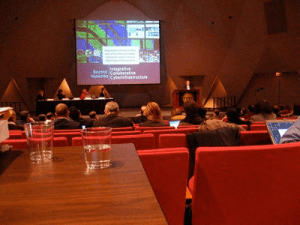
ANOTHER FAMILIAR SCENARIO: Those of you from the IT world recognize this room: PPT up the old wazoo. But then it’s over and the work plans that have been listed on slide 17-23 (if not 117-123) are slated to become deliverables. The listserves get busy, the telecons are scheduled. Perhaps your IT group tracks tasks on BaseCamp and pings you whenever someone else has completed something. But if your not in the critical path, you might not know what others are doing and what your next step is. You might be able to volunteer a couple hours this week, but how do you know where these are best spent?

There might be a couple hundred people like you in the virtual organization (VO) that surrounds this particular project. Some were brought in to advise, others because of a current interest. At the core, decisions are being made and money spent. But the whole idea was that this was more than a distributed project among a small group of  paid Co-PIs. Most of the room was excited about helping move this forward, looking at the outcome as their payback. The workshop cost the government agency $100k to put on, and spent up three person-years in a week.  It had the carbon footprint of a small town.

The feeling of engagement that many participants experienced at the meeting lasted a few days. The funded Co-PIs went back to work. The larger VO languished as everyone else’s calendar’s filled up. Opportunities to pull in the talent and skills of the larger community passed by and dried up.

This doesn’t have to happen.

What is the answer?

One answer is, of course, cash. Spread the funding around and more people pay attention. But that is rarely possible. Another answer is community: grow it, use it, let it manage the work. And give it just enough funding to help people work together.

Be warned: when you let the VO community run the project you invite a range of voices into the room. You have to deal with competing interests and conflicting priorities. The good news is that these interests and priorities were there hidden (more or less) all the time in the VO, so dealing with them is something you can now do and move on. Otherwise you face these same issues when the project of over. To succeed, the VO community will need some form of internal governance. Since you are working with IT professionals, you’d better treat them like peers.

Your peer-based VO community will demand something that looks a lot like a democracy. Do not be afraid. You know that’s not how business gets done. At least you think you know that. In VO communities, democratic governance paves the way for volunteer participation, for leadership, for constructive criticism, and for active attention to the goals of the project. Try getting things done without it.

This is cyberSocialstructure: discussions about Virtual Democracy

Anti Iraq war demonstration

Cybersocialstructure.org will be moving to a Drupal-based website later. In the meanwhile, the discussion about how much democracy is needing for your Virtual Organization (VO) can continue.

CyberSOCIALstructure is destined to be a space where many people add their voices to discussions about the role that social practices (and theories) play in creating and sustaining cyberinfrastructure and CI organizations.
CONTACT: Bruce Caron   bruceATnmri.org
New Media Research Institute, Santa Barbara, CA

CyberSOCIALstructure (CS) looks at the social issues implicit in cyberINFRAstructure (CI). This discussion reverses the usual conversation about the impacts of the Internet on global politics and eGovernment. Instead, CS looks at community and governance as necessary social aspects of building and sustaining VOs.
PHOTO: http://www.stopwar.org.uk/photos/iraq27demo03_05.jpg