From carrots and sticks to donuts and heroin: what academic software producers need to learn from their commercial counterparts.

Carrot and Stick

I’ve spent much of the past decade managing software development projects. These projects can be sorted into two types. One type involves collaboration with academic organizations, mainly with government agency funding. The other type is with commercial partners and an eye toward the open marketplace. Software project management for both types is similar in most ways. Both types used the same agile software development process. The agile project management process includes a conversation about user experience and engagement. In fact, it starts with user problems and stories and use cases.

The notion of customer-driven design is a central feature of all good software development. So too is the goal of creating something of immediate use and widespread need. There are some differences that, when teased out, suggest arenas where academic (and other, open-source) software developers might want to learn something from commercial software development practices. The reverse is not as obvious at the software development level, but is more evident in the user licensing and IP level.  At the code level, the process of development and design for academic/government agency software can be quite different than commercial software. This difference is mainly a matter of user expectations. As Doc Searls noted, “…Microsoft needed to succeed in the commercial marketplace, Linux simply needed to succeed as a useful blob of code” (Searls 2012, Kindle Locations 2262-2263).

A couple of conversations in the academic software code arena can illustrate how far apart these two types are. In the first, I was told that “we can deliver this with the warts showing, as long as it works.” And in the second, someone noted that some combination of “carrot and stick” could be applied to make sure people used the software service. Compare this to the goal that Guy Kawasaki promotes for software: enchantment. “There are many tried-and-true methods to make a buck, yuan, euro, yen, rupee, peso, or drachma. Enchantment is on a different curve: When you enchant people, your goal is not to make money from them or to get them to do what you want, but to fill them with great delight” (Kawasaki 2011, Kindle Locations 185-187). No warts or sticks allowed if your goal is enchantment. In fact, not that many carrots, either.

I countered the carrot and stick suggestion with one of my own, “How about donuts and heroin?” In commercial software development, it’s not uncommon to ask “So, what is the heroin in this software?” The idea is that the customer would be so enchanted with the software that they would gladly use it every day. Even the worst experience should still be a donut, and not a wart, and certainly not a stick.

Certain realities do intrude here. Academic and agency software developers work on the tiniest of budgets. They tackle massive problems to connect to data resources and add value to these. They commonly have no competition, which means they solve every problem on their own. A “useful blob of code” is better than no code at all. But still, they might consider imagining how to enchant their users, and provide a few dimples and donuts along with the worts and the carrots. Because their users spend most of their digital lives on the daily heroin supplied by Apple and Google and Facebook, being handed a carrot may not do the trick.

Kawasaki, Guy (2011-03-08). Enchantment: The Art of Changing Hearts, Minds, and Actions. Penguin Group. Kindle Edition.

Searls, Doc (2012-04-10). The Intention Economy: When Customers Take Charge. Perseus Books Group. Kindle Edition.

Photo credits, CC licensed from Flickr:

carrot and stick: bthomso

carrot on plate: malias

donuts: shutterbean

eating donut: Sidereal

The Intention Economy: a window into the next phase of the Internet

Doc Searls
Doc Searls: The Intention Economy. used under CC license from dsearls on flickr.

I just finished Doc Searls’ latest book. This book is several things, all of them good. This is a knowledgeable look at the future of being a customer in a world where the Internet realizes its potential as an information commons (instead of a storefront). The book is simultaneously about being a consumer and a customer (not exactly the same), and about big data and little data (the data you should be in control of), and about the Internet and the economy. Doc introduces a new (5 years old or so) effort to create software services that enable customers to announce to the world their intentions, and to then receive bids from vendors who wish to sell the products and services that might be some value for those intentions. This is a reversal of rules and roles which currently lock customers into the loyalty silos that companies use to corral their wallets.

Every chapter in this book is a revelation on an important topic, from the coming collapse of the advertising bubble, to the need for customer-based contracts instead of the current lopsided boilerplate contracts of adhesion, to the Internet as a managed commons, which can support individuals owning their own data and negotiating with an open market for what they need: based on their own intentions, rather than from some expensive (in money and effort) algorithm devised to mine their data and ferret these out. Who knows their intentions better than the customer?

The new economy, based on fourth-party brokers that act on behalf of the customer —not the vendor—will be open (newcomers welcome, no silos allowed), efficient (no more guessing intentions, transactions are knowledge-full), effective (allowing vendors to work together), and it will bring the Internet closer to its potential as a free exchange of knowledge that can also support innumerable transactions and contracts. In the end, this is also a story of a work in progress, as Doc and others have already started to build software services to explore this new economy. This is an important work, that announces what could, and I would argue, should be a new direction for an Internet enabled economy.

As a bonus, the work is extraordinarily well written at the prose level, and is not simply a blog-to-book. Each chapter adds substantially to the overall argument. I cannot recommend this book too highly. I am encouraging friends and strangers alike to give it a read.

I would also submit that there are corollaries to the commercial vendor/customer relationship that Doc’s logic and services would help improve. How much better would civil society be if the intentions and the capabilities of citizens, and the problems they face, were announced in this fashion to their local governments? How much more effective would continuing education be if the student could announce the skills they require to the world and have multiple offers for training? The Internet as a managed commons (Doc does a great job of advancing Lewis Hyde’s work on the commons) extends to many facets of our social interactions, not just those that involve transactions for money. Doc does talk about micro-transactions, but there are also new efforts to enable a sharing economy that would benefit greatly from these services.

Doc Searls: The Intention Economy: When Customers Take Charge. Harvard Business Review Press

http://www.amazon.com/The-Intention-Economy-Customers-Charge/dp/1422158527

Hulk want Negroponte Shift in publishing now

It’s one of those weeks where the clanking chains of the ancient devices of academic publishers have been more than a bit annoying, and it looks like no amount of WD40 will smooth the transition into digital delivery without first demolishing these anachronistic machines and their devilish DRM schemes.

This morning on NPR there was a bit on how public libraries need to subscribe each year to access the same digital files for eBooks, in order to provide these in serial increments to individual users. No overdue books here, the narrator notes, the digital files simply disappear from the user’s device, forcing them to queue up (and wait for weeks or months) until the digital file is again available. The more popular the book, the longer the wait.

I also had the opportunity to search for and find a book published by an academic press in Europe, and was informed by their website that I could download a digital copy for only $100+. Makes the iTunes bookstore seem cheap.

And then, with a link from William Gunn, I made myself read a response to the open access demands by scholars, students, and libraries, by a (IMHO fatuous) mouthpiece of the publishing industry in the Guardian. At one point he justifies the bloated profits of the industry by noting that they pay taxes on these (not if they can help it) and the government uses these taxes to fund (wait for it)… research. For profit academic publishers are the “research producers” that keep the wheels of science rolling. Lord help us if the (socialist) open access lumpen masses get their way.

On the more hopeful side, John Wilbanks and the Open Access Gang of Four are most of the way to a successful open access for research petition on the White House petition site. And if only the intern who programmed the Drupal user authentication for that site had hooked in a better module, then it’s likely that the necessary 25,000 signatures would have already been accomplished.

At last look, over at The Cost of Knowledge, 11,923 scholars have pledged to not give their services to Elsevier.

And, today we will find out if Redditors can oust Texas representative Lamar Smith, who co-authored SOPA.

We are all waiting for everything to digital and available and searchable and browsable, and linked, and curated, filtered and yet without the bubble, semantically rich, and, of course, free. We are not there yet, plenty of cruft to clear away. Time to point the Hulk at the entire academic publishing enterprise and say “SMASH.” It couldn’t hurt.

10 Rules for a Santa Barbara Charrette (Part Two: the Final 5)

Part One is here

RULE 6: Use big paper Post-its to gather ideas.

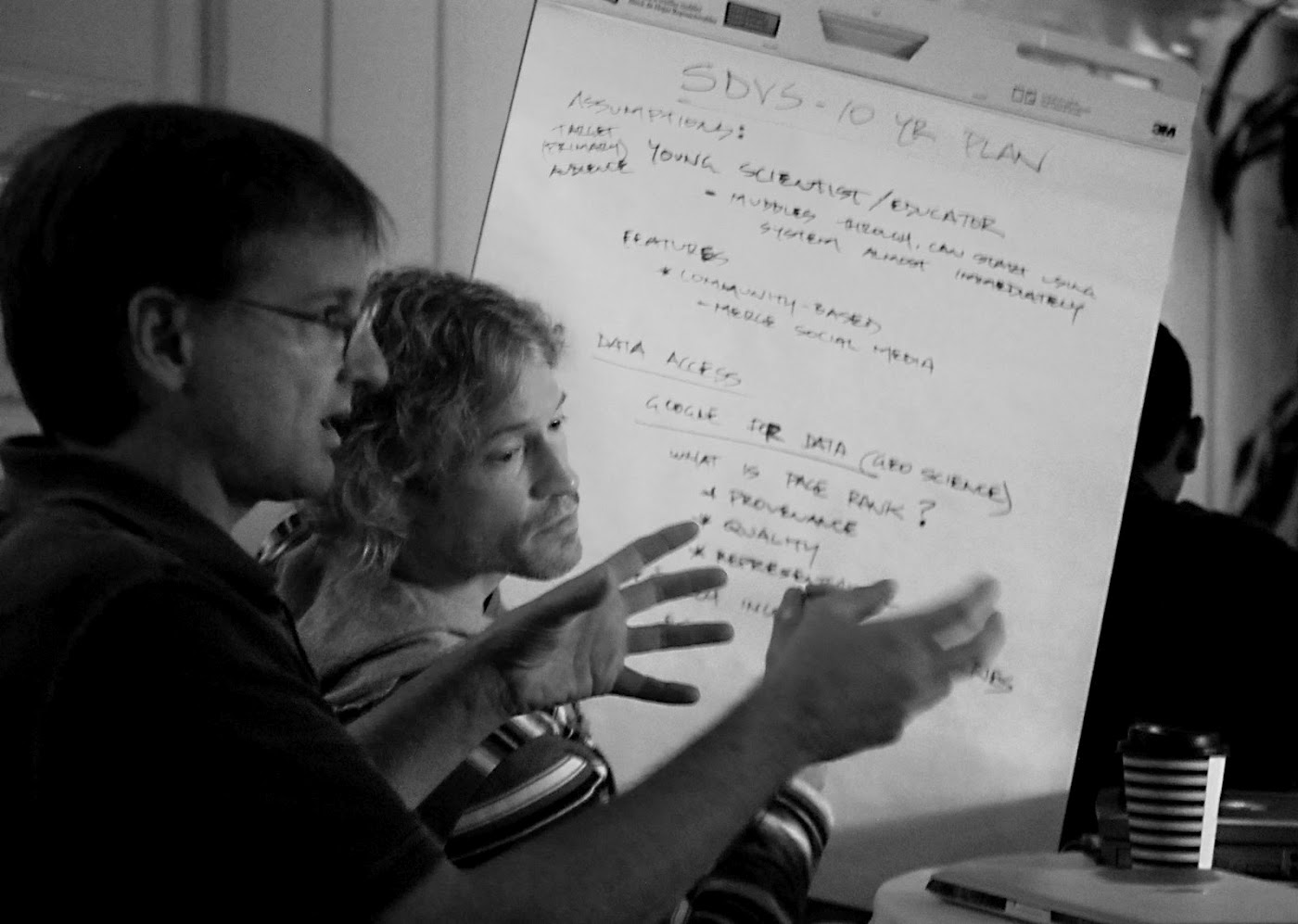
The table conversations need to be captured first on big Post-its. Have the table choose a recorder. All comments are written down. This means that each person’s contribution is captured and made visual for the table. Do not simply write these on a computer. Sometimes the person who made the comment will want to revise this, or expand on it. Sometimes the recorder will not understand the comment, and will ask for clarification. Everyone’s voice is heard in this process. The conversation moves as fast as people can talk. When silence breaks out, the facilitator will come by to ask if the table needs another question.

RULE 7: Create narratives from the Post-its and put these online immediately.

Have a volunteer at each table (graduate students are good for this) who merges the contents of the big Post-its into a narrative. This narrative might be one paragraph, or several. I like to open up a Forum space on a Drupal site for each question, but you can capture these narratives in any way that works for you. Google documents, shared Dropbox: whatever you are most familiar with. The Post-its and these narratives are the output from the meeting. They are the gold you have woven from the ideas of your participants. It is tempting to skip the Post-it and go right to a computer. Do not allow this. The Post-it step is there to keep the conversation flowing and the let each person know their ideas are being captured.

RULE 8: Many conversations in one room.

Workshop planners often make the mistake of having a plenary room and then breakouts in separate rooms. Set up the main room in round tables; all the conversations will happen there. It will get loud, but people will also gain energy from the buzz in the room. And when they are voting with their feet, they only need to meander to another table and join the conversation.

RULE 9: No long introductions. No formal report-outs, but quick checks. No breaks, break anytime.

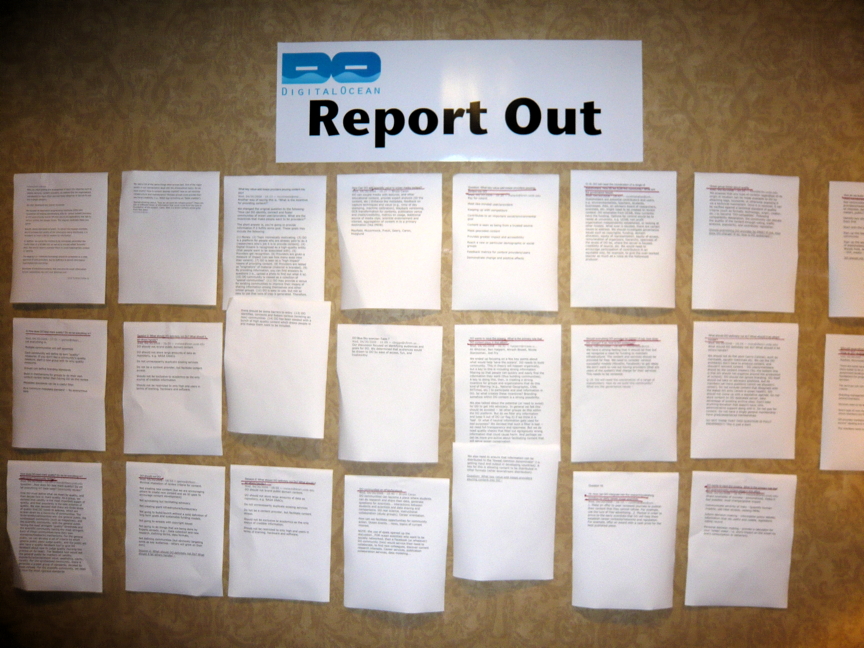
At the start, have each person stand and say their name. Then have them give three words that express their hopes for the day. This should take only 10 minutes.  During the course of the day, have a volunteer print out the narratives from the tables and post them on the wall near the coffee in real time. Let the display of these become an ongoing marker of the accomplishments of the workshop. Do not have any special report-out breaks, this only slows down the conversation. Do not schedule coffee or other breaks (except for lunch if you started in the morning), but encourage everyone to take a break any time they feel like it. They can get coffee, walk around the block, and do whatever they need to gather their attention back to the workshop. Once an hour, the facilitator will do a quick check-in with the room. Stop the conversations briefly to ask if there are any concerns about the process, and remind people to go look at the report-out wall.

RULE 10: Facilitator keeps the conversation going.

The Santa Barbara Charrette is a fast-moving symphony of conversations and inspirations. The key is to keep the ideas flowing, capture these as effectively as possible, and support each table with a supply of questions and a recording mechanism. The main facilitator will walk among the tables ready to supply a new question, or to gather the “hot topic” questions for other tables to answer. The facilitator will also decide when to rotate the tables, and can help keep the process on track.

At the end of the day, be prepared for the participants to be excited and exhausted. They will feel like their ideas have been heard, and their contributions have been saved. When they browse the report-out display, they will see how their table’s answer to the questions exposed different solutions from those of other tables. They may want to be alone after eight hours of constant conversation. They might be ready for some beer. At the end of the day, you will likely have a document that is hundreds of pages long, with multiple insights into the key questions that your organization faces. You will have mined the best ideas from 35 people. And these 35 people will leave the workshop satisfied that their time and their expertise has been well used and honored.

 Final Words

The Santa Barbara Charrette can be used for a wide range of planning and design problems. I’ve also done successful “mini-charrettes” with two or three tables. When you ask anyone who has participated, they will tell you how much fun they had getting their brains picked. They might also note that other workshops, where they are forced to watch PPTs in a room with 100 others, and then raise their hands one-by-one to speak, now seem boring and inefficient. This is the downside of the Santa Barbara Charrette: once you’ve gone there, you can never go back.

10 Rules for a Santa Barbara Charrette (Part One: the First 5)

Building maximum engagement into your workshop

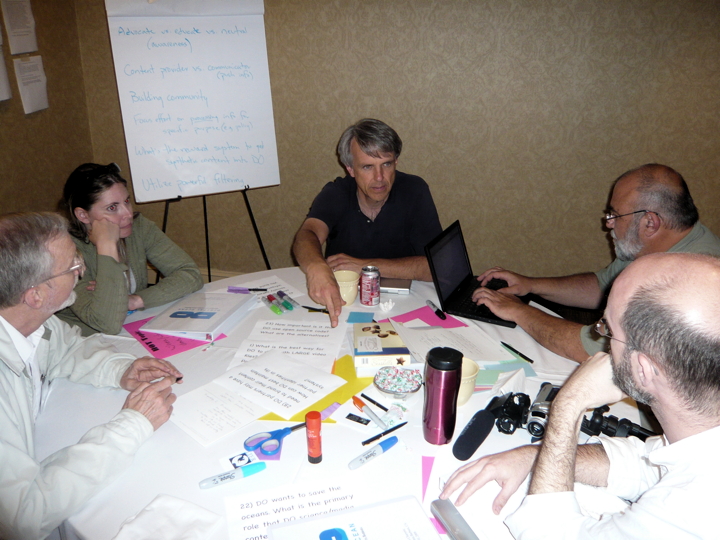
Some years ago I organized a workshop to brainstorm how ocean scientists could find new research and communication capabilities through the use of social networking and social media. With funding from the Paul G. Allen Family Foundation, a team based at UC Santa Barbara was looking to create the next generation of internet-facilitated science. We called the project DigitalOcean. But first we needed to gather as many ideas as we could from thought leaders in a wide range of domains. We needed to have confidence that our plans were well scoped and in the forefront of emerging opportunities.

Participants came from across the US to help the DigitalOcean (DO) team envision this new suite of tools for ocean science. To support the discussion, I looked at a wide range of meeting types, and focused, finally, on an open meeting-style workshop, with a clear set of rules. For an entire day, thirty participants, split into groups of 6-7, discussed a range of issues and provided the DO team with a broad picture of how to move ahead.

I chose the term “charrette” to describe the event in part because of my experience in architecture charrettes at UC Los Angeles, and in part because of design outcomes we desired matched the intensely reflective process that a charrette produces.

In subsequent years, I’ve used the Santa Barbara Charrette model a number of times, and each time I’ve received the same feedback. It goes something like this: “I’ve just worked harder and I’ve also had more fun than I have ever experienced before at any workshop.” At the end, people actually complain of “brain fatigue,” a condition we help cure with beer.

If you are interested in doing your own Santa Barbara Charrette, you follow these 10 rules (The first 5 are here, the next will be in the next blog):

RULE 1: Pick a place that’s right in town and give them dinner/lunch

Before the charrette starts, make sure you feed to participants. Pick a downtown hotel near cafes and bars. Never do this at an airport hotel. If your charrette starts after lunch, feed them a good lunch first. If your charrette starts in the morning, feed them dinner the previous night. But do not try to gather them for breakfast before the charrette. People have a variety of breakfast desires. Have a table with coffee and snacks in the room.

 RULE 2: The ideas need to travel at the speed of conversation. No more than 35/36 people. Small groups all day.

The charrette planning should focus on getting a wide spread of expertise in the room, but no more than about 35 people (7 tables of five, or 5 tables of 7, or 6 tables of 6). The whole day will be used to promote critical conversations at these tables. As soon as the conversation lags at a table, give it something new to do (e.g., another question [see #4 below]).

RULE 3: Open with a blue sky session, get the creative juices going.

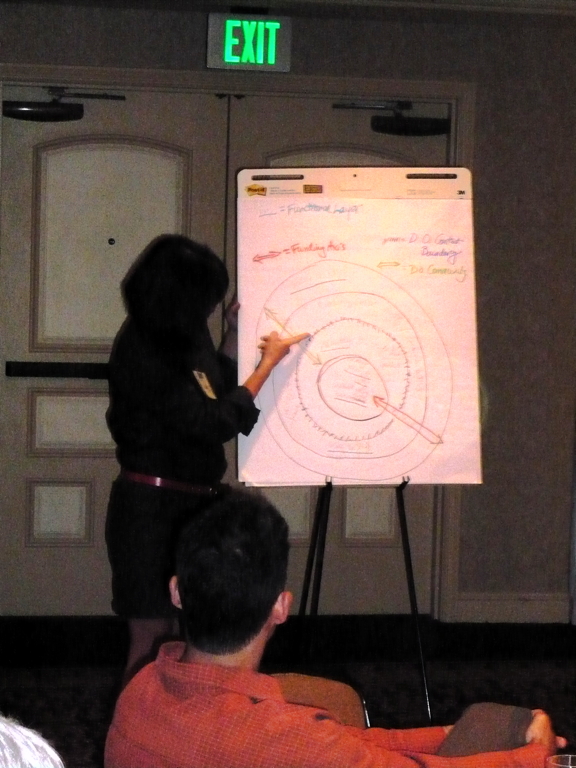
Start the conversations with a real “blue-sky” design problem. Let everyone add their fantasy to the solution of a problem. Give them paper and markers, scissors and glue. Give them props and tape. This is the only session where there is a brief report out. Let the groups compete for the most fantastic solution. Have them map their ideas on big Post-its and then stick these on the walls of the room. This beginning session is designed to help the group achieve an open conversational mode of interaction.

RULE 4: Give them real questions to answer, and let them add to these.

After the blue-sky exercise, each table is given a question to tackle (not necessarily the same question, although most tables might end up answering every question). In the weeks before the charrette, spend real time coming up with 10-12 key questions. Map out how the answers to these add up to a larger picture. Rank these questions as “central” or “if time allows”.  Create some colored sheets of paper that say “Hot Topic” on them. Give each table a few and encourage people to create their own question. Give these questions to OTHER TABLES. Never let someone answer their own question. Some questions will be better answered by tables with specific expertise, others by tables of mixed expertise (see below). This rule was provided by Susan Colitan, Vice President of the Paul G. Allen Family Foundation. The better the questions the more knowledge you will extract from the workshop!

RULE 5:  Break up groups 2-3 times over the course of the day and vote with your feet.

Give each member a name tag (first NAME on both sides). This tag should also tell them which table at which to sit (designated by color, number, animal, etc.). You might want to start by mixing up the expertise at each table. For example the COLOR designated tables might include a technical expert, a managerial expert, some content domain specialists, and others. After a couple hours, have everyone switch to the NUMBER table, which might be grouped by expertise. Later, they might switch to an ANIMAL table, etc. At the end of the day have a final question back at the original table. At any time anyone can move to a different table. This is called “voting with your feet.” Announce this at the beginning and also every time your swap out table designations.

The next 5 rules will be found here: Last 5 rules for a Santa Barbara Charrette.

Imagine your virtual organization (VO) as a street festival

Photo from Flickr. CC by Jesslee Cuizon

I once spent several years studying how communities assembled festival productions in the streets of their towns and cities. This includes almost three years in Kyoto, Japan, and other experiences from South India and the US. The impetus behind this (no, it wasn’t the beer, but that helped) was to see a form of cultural production that was forced to renew itself regularly, and to describe and explain how that cadence of activity could sustain an enormous volunteer effort every year. I was also interested in festivals as they often included activities and behaviors that were not available or advisable on the streets during the rest of the year (aspects of comedy, nudity, violence, politics, joy, and sex: stir together and stand back). The time and space of the festival did not just occur on the street, it transformed the street. Much the same could be said for the impact of the event on the lives of the participants.

I also saw a lot of festivals that failed to transform the street, that had been, somehow, reduced to parades and pageants, to a semblance of their former glory. In these events participation was simply another chore. As such, participants required payment. Volunteerism declined. The vestigial energy of the festival was provided by the music and the movement. But the ability to transform the lives of the participants was lost.

The craft and the logic of a festival event are in many ways similar to that of any virtual organization that hopes to engage its members. The face-to-face meetings or your organization may not achieve actual festivity, but the power of your organization to transform the capabilities and empower the hopes of its members should never be forgotten.

Several years ago I wrote a piece for the Kyoto Journal, “Imagine the festival as a building,” in which I asked readers to imagine their community-based organization (festival or virtual) as a building, a house that is rebuilt from scratch every year. The main messages of this article outlined how the process of designing and constructing the house each year supported the neighborhood in vital ways, and explored how this event would certainly be destroyed when its festival logic is violated, even if an event kept happening.

The essence of a festival logic is honest and free voluntary participation and expression.      A radical form of intimacy emerges. Some scholars tie this back to ancient forms of human physicality (e.g., Cox 1969; Stallybrass and White 1986); however, Anthony Giddens (1992) anchors this form of intimacy also as a hallmark of current modernity. We all want to achieve more moments of intimacy.

Festival logic informs the whole process of design and performance. When you incorporate a similar festival logic into your community-led virtual organization you unleash new levels of member engagement. Street festivals generally focus this energy into artistic forms, while your organization might focus this on product development, creativity, and innovation. If you can imagine your VO as a street festival, you might discover its festival logic. If you cannot, then you might want to ask yourself how to add this logic to your organization.

References

Caron, Bruce. (2011) Imagine the festival as a building… [Internet]. Version 1. lightblueblog. 2011 Dec 25. Available from: http://lightblueblog.wordpress.com/article/imagine-the-festival-as-a-building-2l8t3cliewok9-48/ .  From Caron 2003 http://junana.com/CDP/corpus/COMMENT20.html

Cox, Harvey (1969) The Feast of Fools. Cambridge: Harvard University Press

Giddens, Anthony (1992) The Transformation of Intimacy: Sexuality, Love and Eroticism in Modern Societies. Stanford: Stanford University Press.

Stallybrass, Peter and Allon White (1986) The Politics and Poetics of Transgression. London: Methuen & Co.

On becoming an organization

Carl Rogers, congruence and double-loop governance

In 1961, the psychotherapist Carl Rogers compiled three decades of papers into the book On Becoming a Person. While the main frame of the book describes his client-centric approach to psychotherapy, how he arrived at this and what he learned as a practitioner, many of the articles—which read very much as blogs do today (and were unpublishable in the scientific journals for this reason)—link this frame to other human endeavors. In particular, he looks to education and personal relations in organizations.

His main therapeutic process involves the psychoanalyst as a person, developing her own personhood by becoming more congruent (more about this in a minute) and then using this congruence as a communication tool to open up the client to the process of becoming more congruent. The therapist is really only someone further along the same road to becoming a person.

The process of becoming a person, of achieving more and wider congruence, and so having fewer and fewer defenses, brings the client to a better life, with less tension and fear, better communication with everyone, and new opportunities to explore each moment fully.

Congruence happens when one’s real self (the one we all start out with—all infants are congruent) fully resembles one’s ideal self (the one we acquire from interactions with others). The lack of congruence leads to the need to defend the ideal self every time the real self behaves differently, or when people respond to the real self instead of the ideal self. The real self becomes hidden and, indeed, often unknowable; which forms the reason for therapeutic intervention. The therapist’s more advanced facility with congruence allows her to be less threatening and so to tease the client’s real self out from the shadows, to where the client can repossess this and model their ideal self on their real self. Once they do so, they no longer need to be defensive and they also can speak more honestly from their own minute-by-minute experiences. They communicate better and, in their interactions with others, create the same therapeutic situation they had experienced.

For Rogers, building congruence creates a positive feedback that will foster better communication in an organizational setting; communication where honest reactions and unedited information can lead to more reliable outcomes. These outcomes build more trust into the subsequent situations, which also help all involved become more congruent as persons. The opposite is true for incongruent communication, which leads to fixed limits on what can be said, a growth of miscommunication, an increase in emotional stress, and overall dissatisfaction with the interaction environment. Rogers’ “Tentative Formulation of a General Law of Interpersonal Relationships” (Rogers 338-346) reads very much like a Web 2.0 manual for creating a high-trust, flat-management start-up company in 2012. He was 50 years ahead of his time.

Rogers’ general law maps directly onto double-loop governance, with the real organization being the first loop, and the ideal organization being the second loop. Instead of hiding the ideal organization behind the intentions of the founder, or top-down rules and regulations, double-loop governance makes the ideal organization available to every member. Each member has the same view and purview of the rules and roles, the values and the vision of the organization, and also an obligation to make these congruent with the everyday activities of the organization.

The notion that your organization can also be a therapeutic setting where members can learn to become more congruent may seem peculiar. Remember that the interactions are really a series of conversations between two people. Your organization is only setting the circumstances where members can communicate effectively. We all remember meeting people whom we knew were open and honest, trustworthy people. We tend to forget that when and how we met them framed their ability to reveal themselves and so help us learn. You can make your organization a place where each member can become more a person. In return they will make your organization a better place in which to get things done.

References

Rogers, Carl R. (1961) On Becoming a Person: A Therapist’s View of Psychotherapy. Boston: Houghton Mifflin.

Use a virtual organization to borrow enough requisite variety to innovate in a data-rich world

Photo from Flickr, used with CC license. by http://www.flickr.com/photos/dominik99/

What can you do when your research team says, “This is way too complex.”

When your government agency or university laboratory looks to innovate in a world where multiple/large data inputs are coming on line, how can you stay ahead of the inherent complexity of the systems you are creating/interrogating? One way to look at this problem is through Ashby’s principle/law of requisite variety. A principle of cybernetic management, requisite variety notes that unless the control system has at least the variety of the environment it controls, it will fail. Which actually means that some part of the environment will be controlled elsewhere. Elsewhere is also where innovation happens; because unless you can corral the inherent variety of the problem you face, it will seem too complex for your team to innovate a response (Kofman [1]).  You can either go out and hire a bigger team, or you can borrow enough requisite variety just long enough to bring your own team up to speed. That is a great use for a virtual organization (VO).

Theorists of knowledge management have applied Ashby’s law in various modes, including a thread of interest in what is called a “learning organization” and mode of business communications management known as “systems thinking.” [There is a great amount of information about this available at the Society for Organizational Learning http://www.solonline.org/.]  The point they make is that the team you build to tackle a tough problem needs to have enough of a portfolio of knowledge and skills to address all parts of the problem. Not only that, but they need to communicate their skills and knowledge to one another so that each team member shares in this collective intelligence. Andrew Van de Ven put it this way, “Requisite variety is more nearly achieved by making environmental scanning a responsibility of all unit members, and by recruiting personnel within the innovation unit who understand and have access to each of the key environmental stakeholder groups or issues that affect the innovation’s development.”  (Van de Ven, 600).

Virtual organizations include online communities, research collaboratories, open source software programmer collectives, and other groups in a great variety of arenas and professions. What they offer is an open network of common interest and complementary talents. When your business or agency is looking to innovate in a world where data are more plentiful than insights (Abbott, 114) then it makes great sense, in terms of time and effort, to join a VO and gain enough requisite variety to conquer complexity and kickstart some innovation.

References

Abbott, Mark R. (2009) “A New Path for Science?” in The Fourth Paradigm: Data-Intensive Scientific Discovery. Hey, Tony, Stewart Tansley, and Kristin Tolle, eds.  Pp. 111-116. Redmond: Microsoft Research.

Fred Kofman [1]   http://www.youtube.com/watch?v=4ARZBxIzsKk&feature=relmfu

Van de Ven, Andrew H. (1986) “Central Problems in the Management of Innovation.” Management Science. Vol. 32. No. 5. (May.) pp. 590-607.

Part 2: Immunize your virtual organization from institutional guilt

Image from Flickr. Used under CC license. Photo by USACE http://www.flickr.com/photos/europedistrict/

The 5 ways that double-loop governance can save your organization from itself

Institutional guilt (see Part 1 below) is routinized violation of your organization’s values, vision, rules, or policies. It is symptomatic of dysfunctional communication strategies inside an organization. It leads to distrust of staff and disengagement from the organization’s vision. Staff and volunteer disengagement/disenchantment is a prime reason non-profit organizations fail (Duckles, et al 2005).

Institutional guilt is something that will ruin your virtual organization. It poisons the culture and it drives away volunteers while it demoralizes your staff. Implementing double-loop governance is a good way to build in protection against institutional guilt. You also need to be sure that your employees and volunteer committees do not fall into the trap of violating your own values and policies for some immediate purpose. Double-loop governance opens up learning capabilities and communication channels to help limit and repair occasions where volunteers or staff do stray from your organization’s vision and values.

1. Double-loop governance makes every member a caretaker of the vision and values for the virtual organization. 

Your values are not just a bulleted list on your website nor a poster on the wall. They are the deep logic of why your organization exists. When you create the knowledge loop that includes questioning and reaffirming your values into every decision, then your staff and volunteers can celebrate these values. Membership includes embracing the values, and entering into the ongoing conversation about them that keeps them current and vital.

2. Double-loop governance makes a virtue out of transparent decision making.  

Transparent here means available to all members (not necessarily public). Practically, transparency includes time and place availability. Members are told when and where a decision is being made. For a virtual organization, this might be a set period of time to edit a certain wiki, or a set period in which to vote online. The management of critical-path decisions may (and usually should) devolve to active subgroups charged with delivering the outcomes. These subgroups need to maintain their own transparent decision process. A great example here is Wikipedia, where each entry contains the edited text, a history of edits, and a discussion page about the text and its edits.

3. Double-loop governance brings conflict to the surface. 

Conflict avoidance is a major source of “unusual routines” (Rice and Cooper 2010) in general, including those that create institutional guilt. Conflict can arise in many forms. Personal issues surrounding time commitments, responsibility and authority, and expectation management cannot be avoided through double-loop governance alone, but they can be openly addressed and resolved in a manner that promotes reflective learning among those involved. Evaluation conflict avoidance happens when tests of deliverables are either postponed, curtailed, or done in private. Double-loop governance supports open and thorough testing, and the disclosure of competing interpretations. Conflict is rapidly promoted to the surface of discussions, where voices of dissent become available to all members. Resolution is commonly achieved through a working consensus, not 100% agreement, but something more robust than a simple majority. Conflicts over the underlying assumptions of the organization can result in new values and a new vision: the organization is free to pivot toward a novel direction at any time.

4. Double-loop governance accelerates failure to ensure success.

Remember that double-loop governance supports double-loop learning. Single-loop learning focuses on avoiding failure.  Double-loop learning focuses on using failure to recalibrate the underlying assumptions of the activity, this promotes the act of failing as a learning device, and a logic of rapid iterations of activities with open testing.  In software development efforts, double-loop governance actively supports agile development decisions. In all endeavors, the ability to fail quickly and recover takes the fear out of trying new strategies.  This almost guarantees a better final result.

5. Double-loop governance supports do-ocracy and emergent leadership. 

While not all double-loop governed organizations are strict meritocracies, the best find ways to recognize and reward achievements and contributions. One of the benefits of the network effect is an ability to reach out beyond the founding team and find people who have similar interests and valuable skills. As the network expands, the chances of encountering tomorrow’s leadership improves. When these people become engaged in activities and outcomes, they need to have a clear path to leading subgroups and then larger groups, and ultimately the organization.

Final Thoughts: Double-loop your organization and forget the guilt

Remember that decisions that don’t get made by the people who are supposed to make them get made anyhow by the people who need them. Even the decision not to decide today is made by someone. When decisions are guided by the values and vision of the organization, when the process is transparent, when the conflicts appear on the surface, when failure is just another chance at success, and when leadership opens up in front of those who have proven their worth: that is when institutional guilt has no purchase on the logic of your organization.

References:

Duckles, Beth M., Mark A. Hager, and Joseph Galaskiewicz (2005) “How Nonprofits Close: Using Narratives to Study Organizational Processes.” Pp. 169-203 in Qualitative Organizational Research: Best Papers from the Davis Conference on Qualitative Research, ed. Kimberly D. Elsbach. Greenwich, CT: Information Age Publishing.

Rice, R. E. & Cooper, S. (2010).  Organizations and unusual routines: A systems analysis of dysfunctional feedback processes.  Cambridge, UK: Cambridge University Press.

Part 1: Don’t let institutional guilt drag down your virtual organization

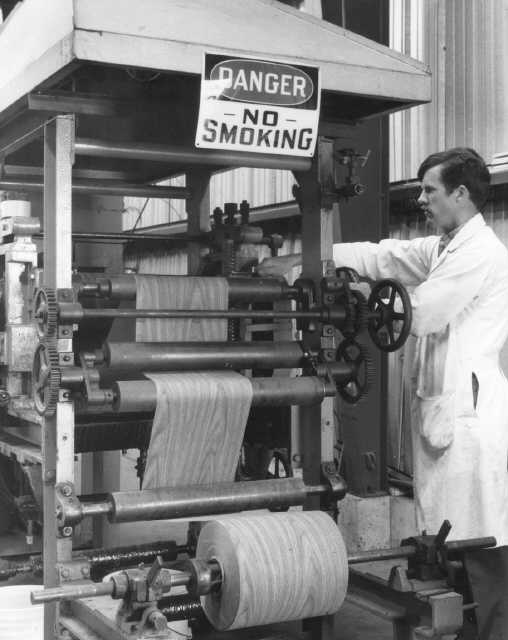
Making fake wood
I made fake wood out of paper and plastic for a summer

Institutional Guilt: you know it when you see it

You may have experienced institutional guilt directly, and you’ve likely seen this on TV. Remember the cop show where the new recruit, still wet behind the ears, with a new house, a young wife and a family member (usually a child or a parent) who has a horribly expensive medical condition; this new recruit, who has every need for some extra money is standing near his locker when his sergeant claps him on the shoulder and hands him an envelope. “This is your cut,” he says, and walks away, leaving the recruit to either take the money or buck the system. So the rest of the movie all about how the organization is rotten at the core, which is exactly what institutional guilt does.

I experienced institutional guilt when I was working at a chemical factory on the Tacoma waterfront during the summer of 1972. (The above photo, taken in 1971, is like one of the machines I worked for that summer. The fake wood grain on the paper is called “Mediterranean Oak.” I sort of remember the guy in the photo, he was the chemical engineer on staff.  Source: Tacoma Public Library.) One night, during the graveyard shift, I noticed that someone had opened up a pipe into a storm drain, a pipe which was always supposed to be sealed and only emptied into drums labeled appropriately for their toxic content. I mentioned this to the crew chief and he asked me if the inspector was there. Of course not, the inspector went home at 5.

The next time I was on a day shift, I told the plant supervisor that the pipe was left open at night, and all the extremely nasty chemicals were being discharged directly into Commencement Bay. He looked like I had told him I saw him microwave a kitten. This was information he did not want to hear, but he reacted like it was something he already knew. He told me to get back to work, and retreated into his office. I don’t remember ever speaking to him again. Then again, I don’t think I ever worked the day shift again. I never trusted the company after that, and I developed a reputation for not following orders to do certain things that others would do. Plenty of people there had new houses and young spouses and kids with expensive medical bills, and didn’t ask many questions.

I would suggest that other employees didn’t trust the company either. Almost daily they were asked to do tasks that were explicitly prohibited by policies posted on the bulletin board. They could be fired for any of these infractions, or they could make a complaint about their supervisors at any time. There was plenty of guilt to go around. This was a company that paid union wages for manual labor, so there was a steady supply of workers. This was fortunate for the company, as there was a steady turnover of employees.

Institutional guilt happens when values and vision, and policies and processes are routinely broken. The routine creates an alternative policy, a counter-value, which becomes the operational norm for the organization. As this new policy and its values cannot be spoken of, it is almost impervious to change. “Rotten at the core” is a good analogy here. For a virtual organization this situation will lead to almost certain failure; volunteers and staff will flee. Those that remain do so for suspect reasons.

The routines that include institutional guilt are a subset of what Rice and Cooper (2010) call “unusual routines.” These are dysfunctional outcomes of flawed communication practices (and other sources). There is no organizational structure that can prevent these entirely, and there are practices available, however expensive (e.g., firing all the staff and starting over) to repair unusual routines. Double-loop governance and the communication practices that this supports and promotes can preempt institutional guilt in several ways. I will be outlining these in the next blog.

How have you experienced institutional guilt? What is your story?

 Coming next: Part 2: Immunize your virtual organization from institutional guilt

Reference:

Rice, R. E. & Cooper, S. (2010).  Organizations and unusual routines: A systems analysis of dysfunctional feedback processes.  Cambridge, UK: Cambridge University Press.